
By Gary Lloyd
The Boston Celtics draw basketball fans from all over the country, and for the last two seasons, I’ve driven to Atlanta to see my favorite green-clad NBA team take on the Hawks.
I’ve heard Celtics fans standing in winding State Farm Arena lines speak with thick northern accents about how T.D. Gaaahhhden is wicked bettaahhh than other arenas, and others who said the drive south on Interstate 85 from South Carolina in their F-150 was “all right, I reckon.” I go to see the Celtics, of course, but I leave early enough to see some sights.
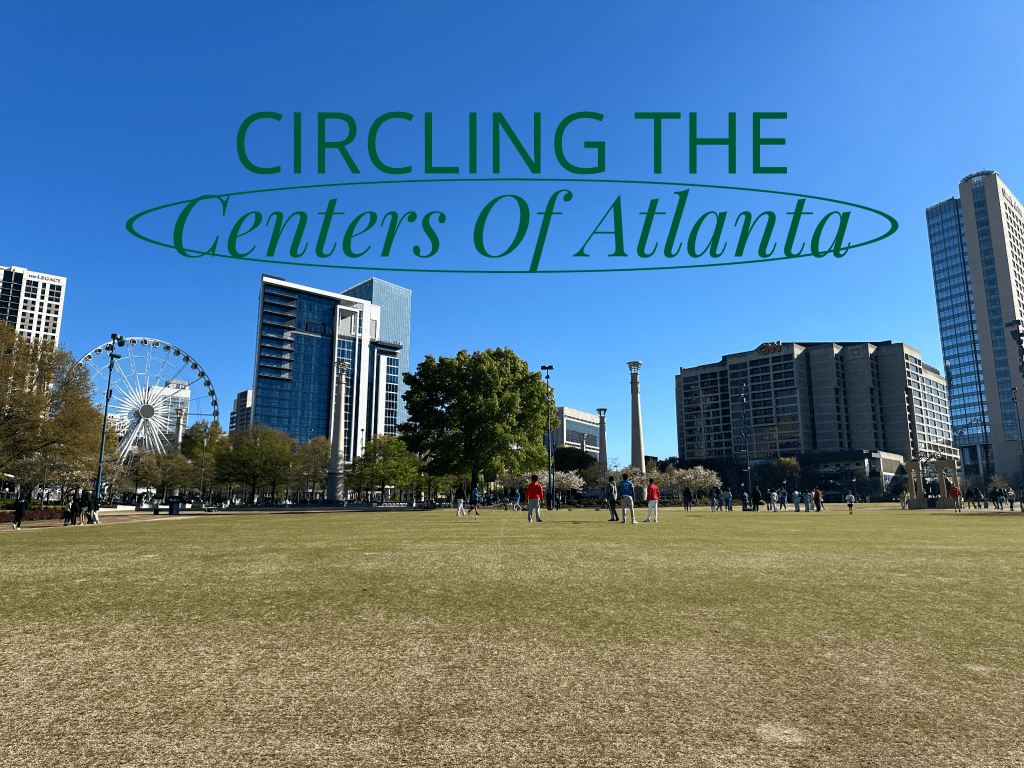
For almost an hour last year, I wandered around Centennial Olympic Park, a large park built in the 1990s as part of the infrastructure upgrades for the 1996 Summer Olympics. The wind tunnel created by the surroundings landmarks – Georgia World Congress Center, College Football Hall of Fame, State Farm Arena, CNN Center, Georgia Aquarium, and more – made it difficult to keep my green hat on my head. I circled the park slowly, taking time to read the “1996 Summer Olympics” historic marker. If I were a moth, historical markers would be the flames. I read names on commemorative bricks and took photos of the Richard Jewell Remembrance memorial in the fountain basin, located near the spot where a pipe bomb was detonated by a domestic terrorist in the wee hours of July 27, 1996, during a late-night concert.
In September, I came back to Atlanta for the PGA Tour Championship with my dad and brother. I was struck by the new Hank 565 apartment complexes surrounding the former Atlanta-Fulton County Stadium location, which was demolished in 1997 to make way for a parking lot for the then-new Turner Field, which is now home to the Georgia State football team. The skyline I once knew is gone. It’s how I felt driving down Paul W. Bryant Drive for last year’s Alabama High School Athletic Association Super 7, when the Tuscaloosa clouds were blotted out by apartment buildings that seemed to rival the height of Bryant-Denny Stadium Upper Level 4.
There might be apartments, another new Publix, yet another Starbucks, another brick-this and brick-that, but there is also preservation. Centennial Olympic Park has been preserved and is an amazing testament to local and national history, tragedy, and remembrance. The same can be said for Atlanta-Fulton County Stadium which, yes, was demolished, but the retaining wall over which Hank Aaron’s record 715th home run – still the record-holder for home runs, as far as I’m concerned – sailed over in 1974. It is a literal parking lot for Georgia State football games, for Tour Championships, and more, but that section of the wall is still there, a modest baseball-shaped sign adorning it that reads “Hank Aaron Home Run 715, April 8, 1974.”
“Progress” is a word I often struggle with. What does it truly mean? Does it mean more commercial businesses? More convenience? More overrunning of current infrastructure? Call me a curmudgeon, a get-off-my-lawn old man, but I enjoy finding these preserved historical spots across Alabama, Atlanta, and the country. I can’t get enough of them.
I’ll return to Atlanta this month to see the Celtics hopefully beat the Hawks. I wonder what I’ll find this time.
Gary Lloyd is the author of six books and a contributing writer to the Cahaba Sun.
 Gary Lloyd Books