This page has been created for a historical tour of Trussville, Alabama, for Leadership Hewitt-Trussville. Enjoy!
STOP 1: Mason-Dixon City
Faith Community Fellowship parking lot
Mason-Dixon City: The Birmingham News in November 1927 published articles about a new city being planned for Jefferson County. The modern city would be complete with a golf course, lake, clubs, theaters, schools, churches, stores, industries, factories, homes, and – most famously – movie production studios.


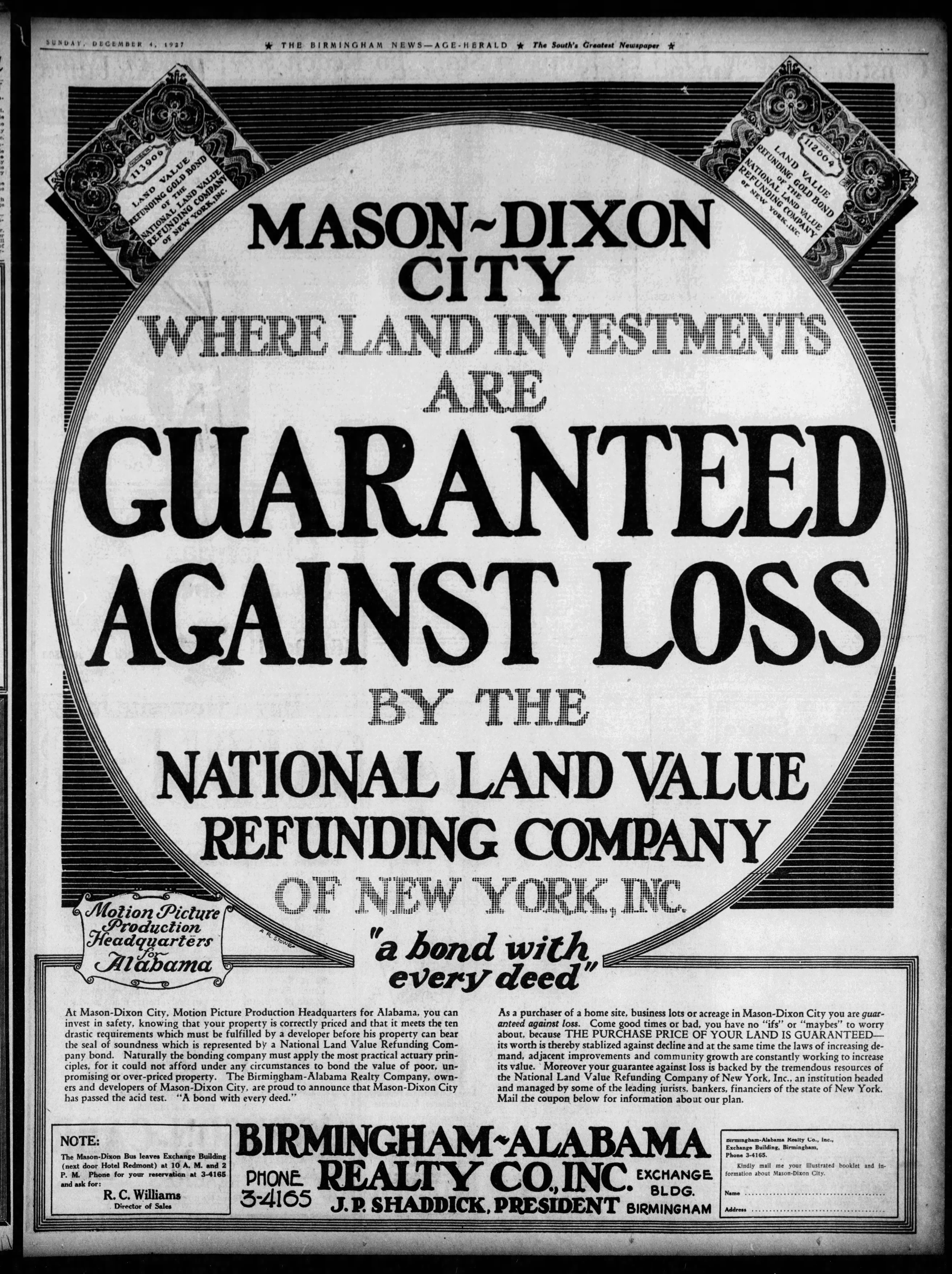
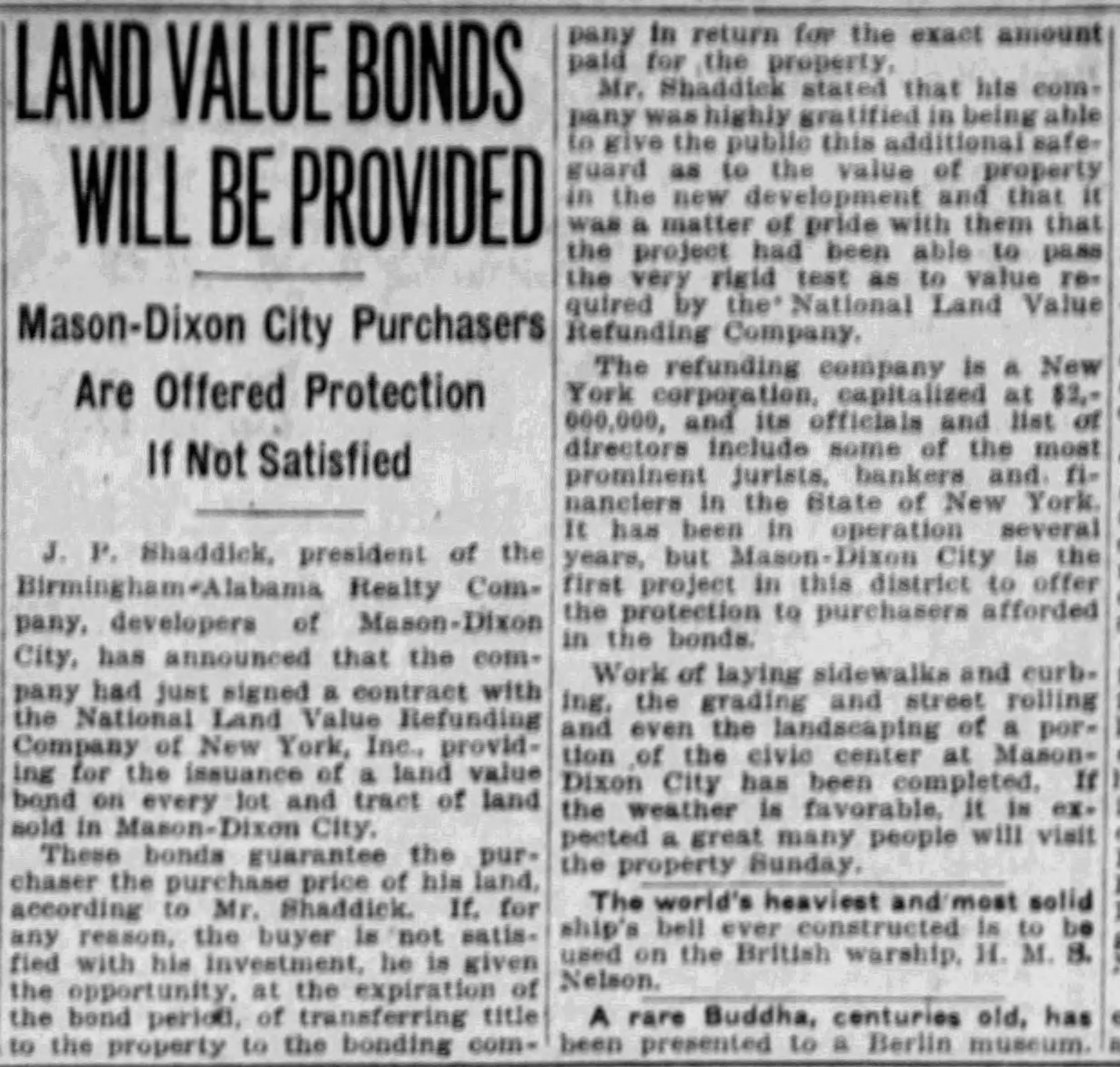
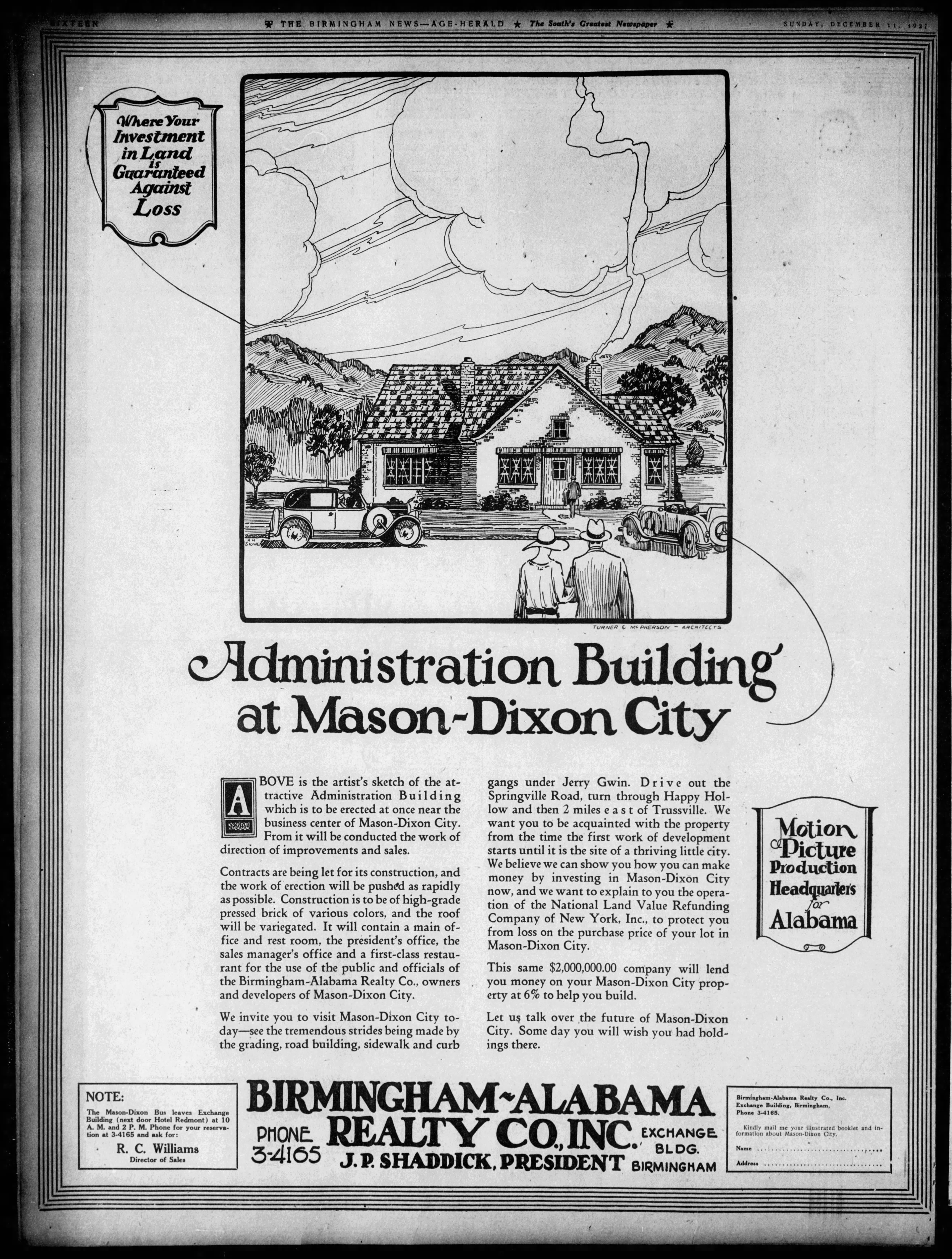
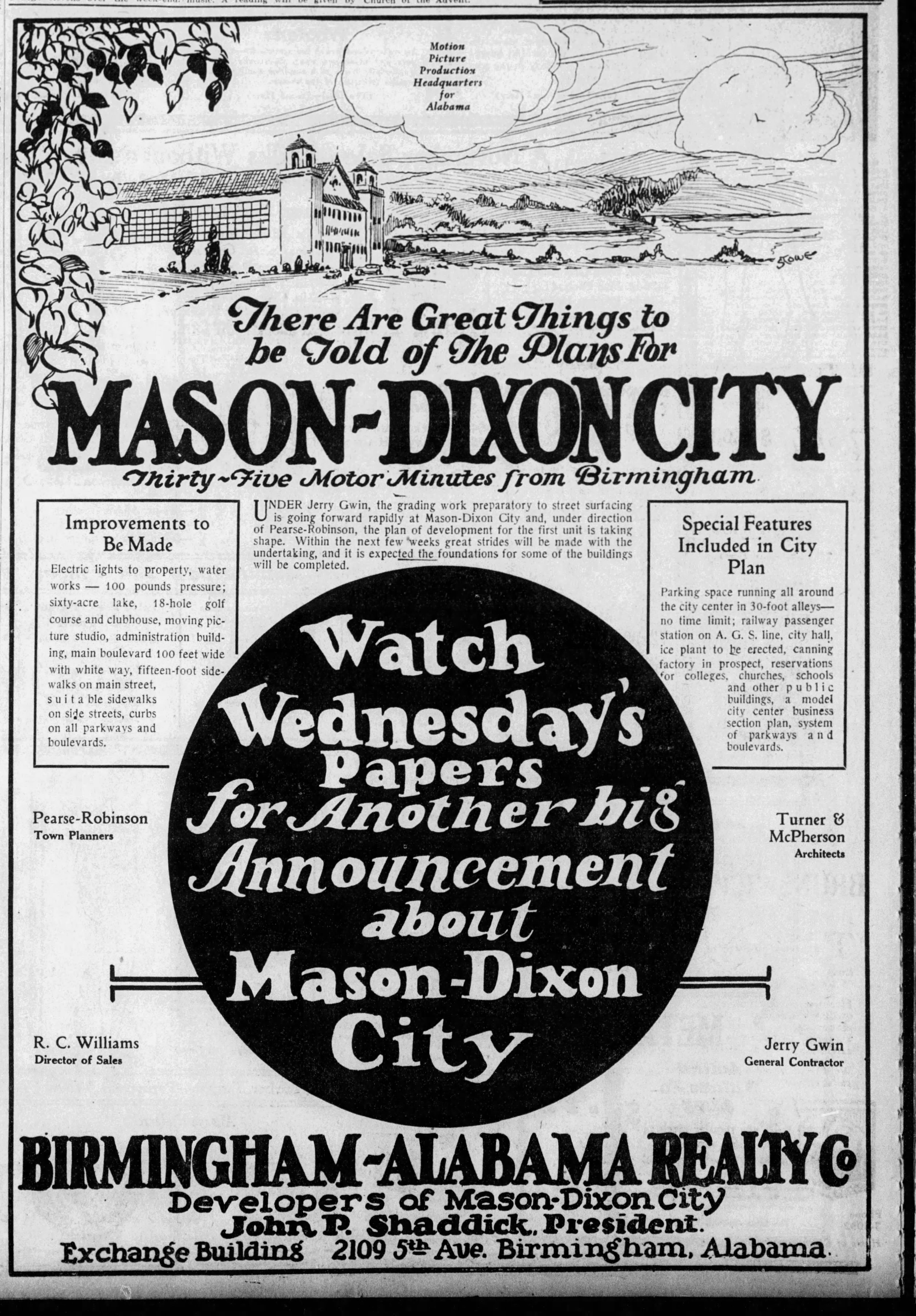

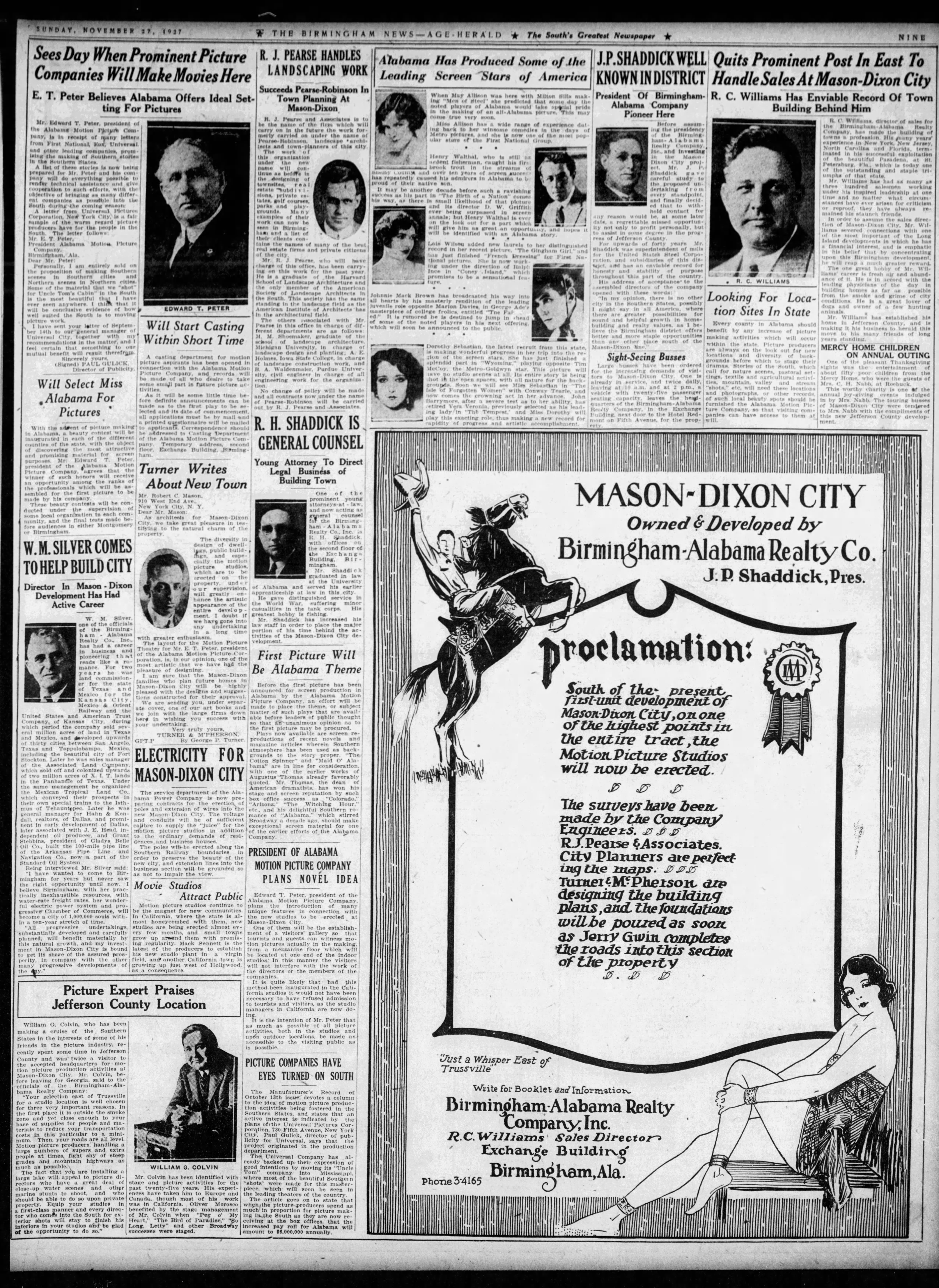
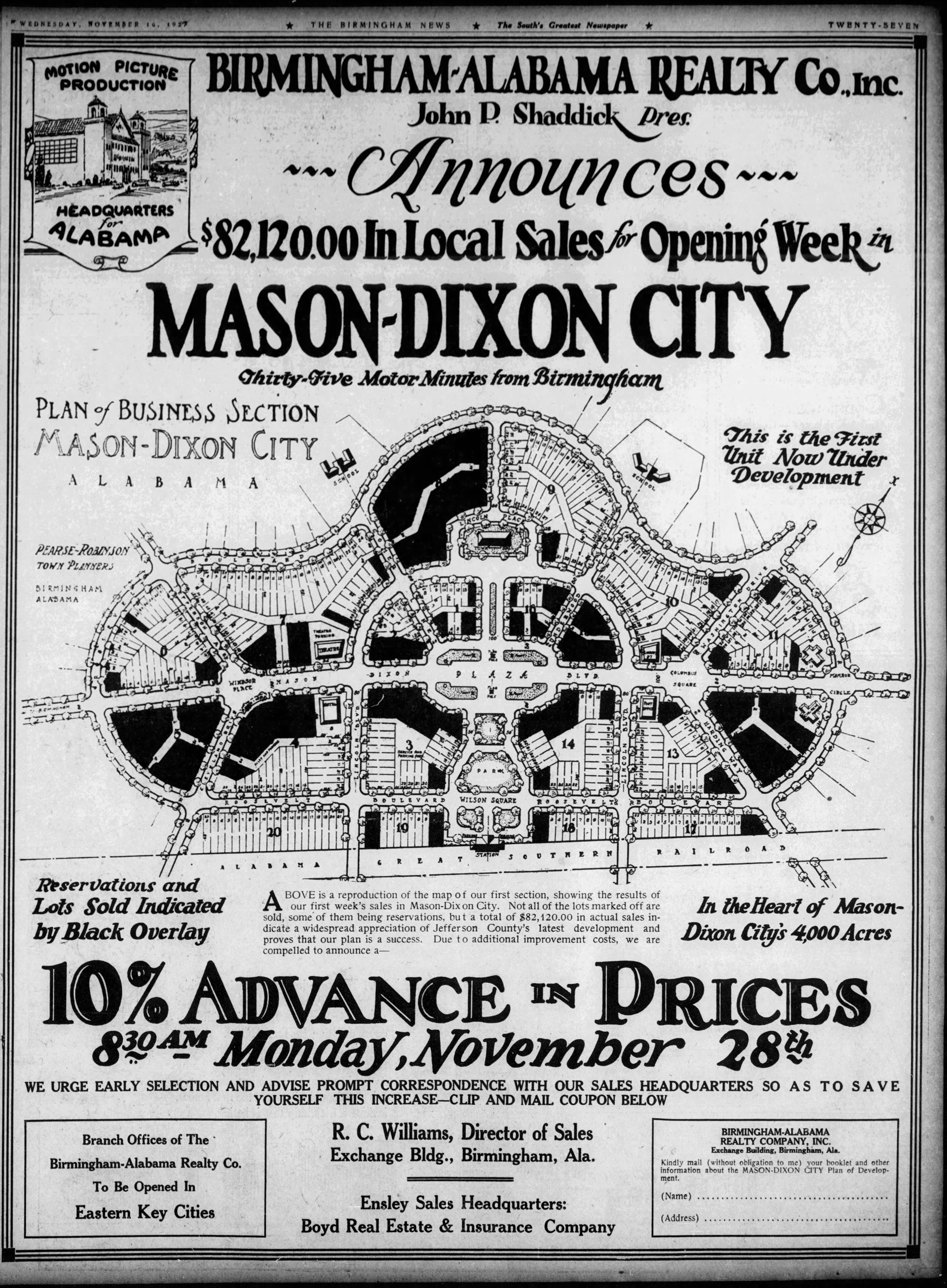
The location of this modern city? Right here where Amerex Corporation, Paine Elementary School, Faith Community Fellowship, etc. are. It was to be called Mason-Dixon City.
Of the 4,000 acres planned for development into a city, 300 and an adjoining 65-acre lake were dedicated to building Mason-Dixon Studios. Plans were drawn. Lots were bought. It was a sure thing. But only 2 buildings – a large sales office building and one model home – were ever constructed. Why? The Great Depression.
The Birmingham Development Co. sold Mason-Dixon City to the Granada Development Co. in December 1928 and in 1929 the stock market crashed, and Mason-Dixon City along with it. It never happened. It could have been the Hollywood of the Southeast. We’ll never know. Instead, the sales office building became Fred & Jean’s Tavern and dance hall, which was located near the entrance to Faith Community Fellowship. The tavern and the model house were, apparently, in much later years destroyed by fire. The only remnants of Mason-Dixon City are the curbs of the streets that were made.
[Amerex Corporation/Paine Elementary/Industrial Park/Camp Coleman back down Highway 11]
Amerex Corporation:
The largest industrial tenant in the city of Trussville is Amerex Corporation, the world’s largest manufacturer of hand portable and wheeled extinguishers for commercial and industrial applications.
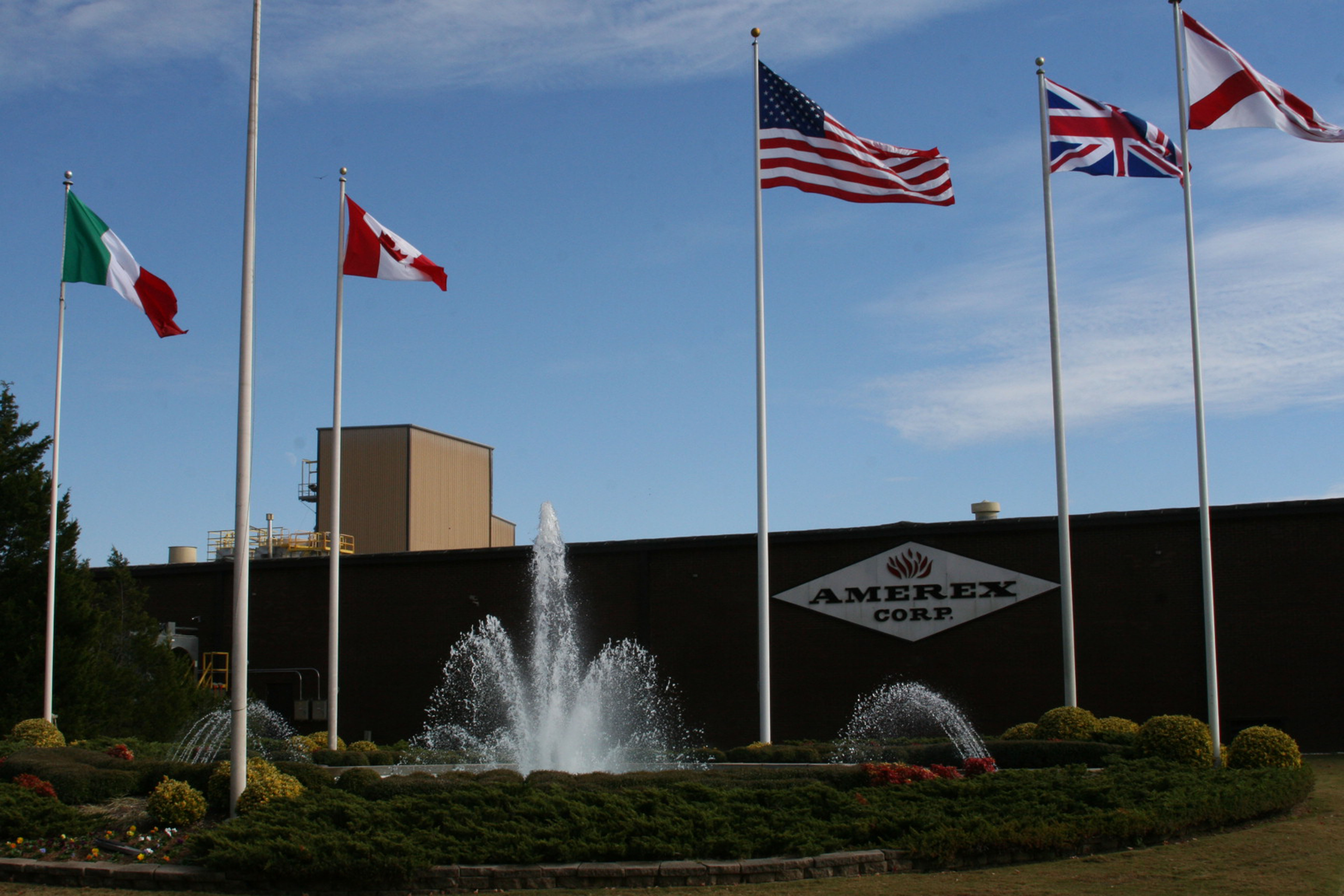
Ned Paine founded Amerex Corporation in Trussville in 1971 and served for 20 years from 1993 to 2003 on the city’s Industrial Development Board. Paine retired from the company on September 30, 1999. Paine, who served also on the Jefferson County School Foundation, helped fund the facilities and establish a program for a technical education lab at Hewitt-Trussville Junior High School. In 1999, he and his wife, Goldie, donated 31 acres of property along U.S. Highway 11 near Amerex Corporation for what is now the campus of Paine Elementary School. He was chairman of the committee that determined it was feasible to start a Trussville school system and served as a charter member of the board of education in Trussville from 2004 to 2005.
The Hewitt-Trussville High School softball field off Trussville-Clay Road is named in Goldie Paine’s honor.
Trussville Industrial Park:
It appears the Industrial Park was created and opened in the early 1960s. Light industry is what dominates this area of Trussville. The Industrial Development Board recruits industry for open spaces and is in the process of creating pad-ready spaces in open sections of the Park now.
Camp Coleman:
Girl Scouting was founded in 1912 by Juliette Low, and 10 years later, Girl Scouting began in Jefferson County, Alabama. On May 22, 1925, the Girl Scouts of Jefferson County incorporated for the express purpose of buying land to establish a camp. That land was located on the more northeastern side of the city, along a stretch of the Cahaba River. The camp opened in 1925 under the name Camp Gertrude Coleman, named after its first commissioner, who died six months prior to its opening.


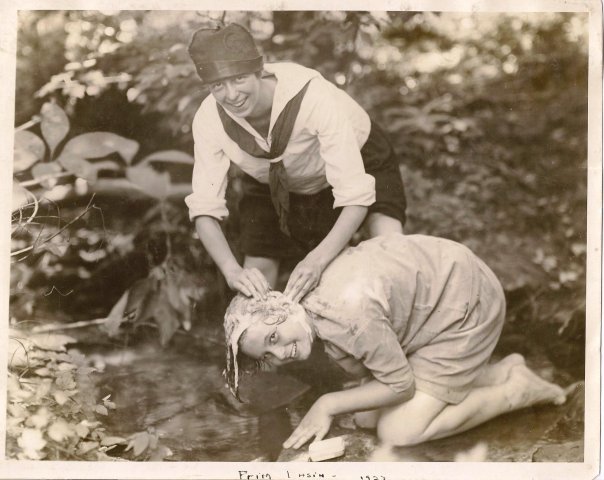

Camp Coleman is the third-longest operating Girl Scouts camp in the United States and the longest continuously operating Girl Scouts camp in the state of Alabama. The camp even remained open during the Great Depression and World War II because of the dedication of its attendees. Most camps closed during this time so that their leaders could contribute to the war effort.
Camp Coleman consists of 34 wooden structures and outbuildings constructed between 1925 and 1994. The director’s cabin was built in 1925 and is the oldest structure at the camp, which is situated on about 140 acres of land along the Cahaba River.
The 89 years of continuous operation of Camp Gertrude Coleman was threatened on May 9, 2012, when the Girl Scouts of North-Central Alabama Board of Directors voted to approve a three-phase property plan, which included closing and divesting Camp Gertrude Coleman, Camp Anderel in Rogersville, Camp Tombigbee in Greene County and Camp Trico in Guntersville. The plan was the result of significant operating losses in 2011. As part of the plan, Camp Coleman and Camp Trico would permanently close on May 31, 2013.
On the day the Girl Scouts of North-Central Alabama Board of Directors voted in favor of the three-phase property plan, a group of Girl Scouts alumnae gathered in a living room and formed Friends of Camp Coleman, a group whose goal was to preserve Camp Gertrude Coleman and its outdoor opportunities to build girls of courage, confidence and character.
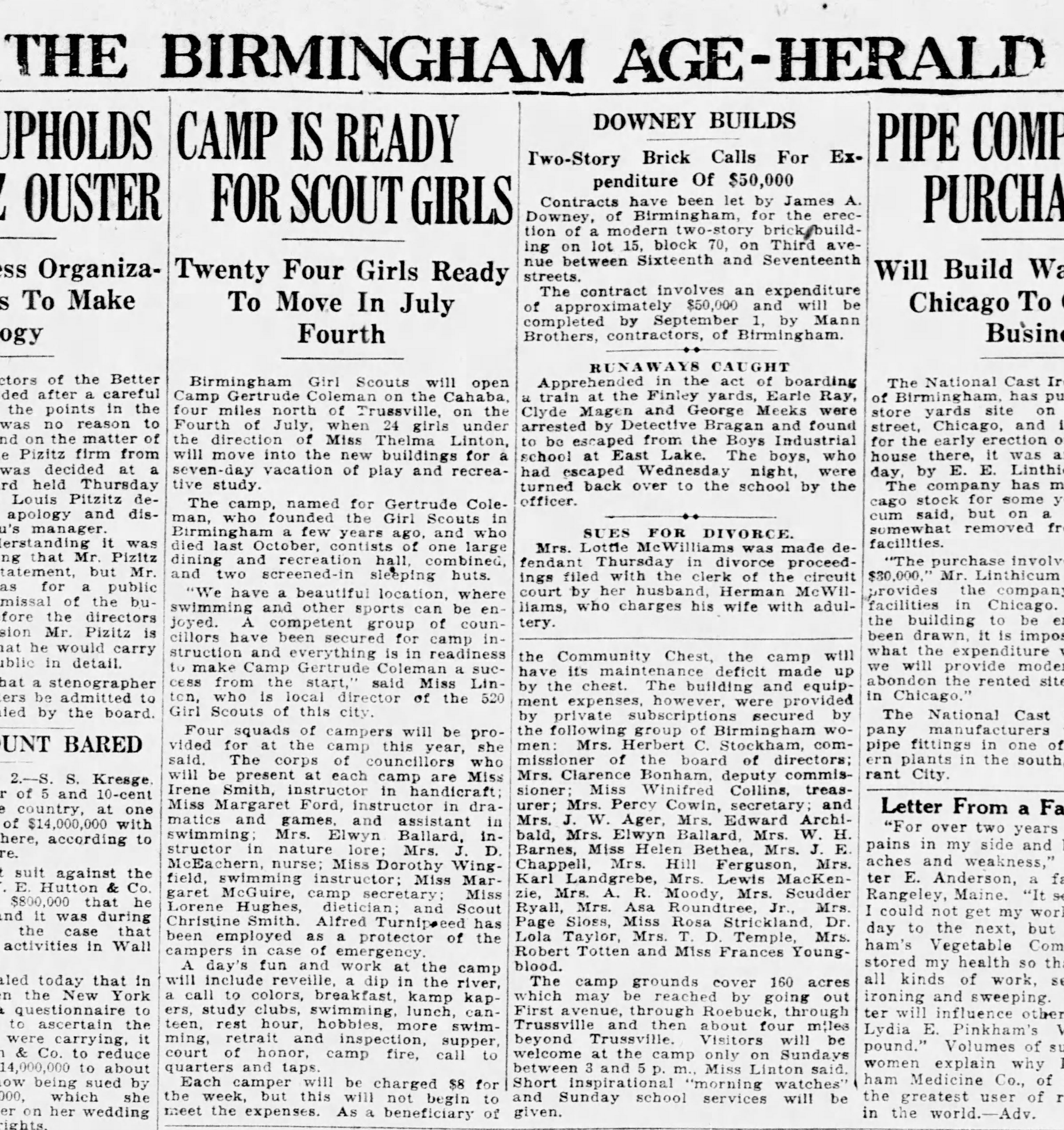
In March 2013, Trussville Mayor Gene Melton offered for the city of Trussville to buy the camp for $700,000. The 140-acre site had appraised for about $2.1 million. Melton wanted the camp to remain a protected green space in Trussville and for Girl Scouts to continue to use the property. The Girl Scouts of North-Central Alabama rejected his offer.
On May 29, 2013, two days before Camp Coleman was set to be permanently closed, the Girl Scouts of North-Central Alabama Board of Directors approved an amendment to the three-phase property plan, choosing to rest Camp Gertrude Coleman and Camp Trico while the new Board of Directors, which was elected a month prior, further evaluated the three-phase property plan. The approval ensured that Camp Coleman would continue to be the longest continuously operating Girl Scouts camp in the state.
On June 12, 2013, the Girl Scouts of North-Central Alabama Board of Directors unanimously voted in favor of a resolution to reconsider the three-phase property plan. On November 20, 2013, the Girl Scouts of North-Central Alabama Board of Directors unanimously passed a resolution that allowed the closed and rested camps, including Camp Coleman, to be used on a limited use basis for troop camping beginning in January 2014.
And now, as we approach 2025, it will have been operating continuously for 100 years. I’ll be writing about that in 2025, you can be sure.
STOP 2: Jefferson County Convict Camp No. 3
Park at Veterans Memorial Monument
Jefferson County Convict Camp No. 3:

I can’t tell you a lot about this camp, but I can show it to you. I’ve researched this place a little bit this year, but I’ve only gotten so far.
I know it was here in the 1920s and closed in 1935 when the surrounding land was bought by the federal government for the purposes of constructing what we now know as the Cahaba Project.
I know there were escapees, a flogging incident that went to court, and roadwork done by the inmates here. I know it was here, and that in a way, it still is, because you can still find its foundation, its bricks.
STOP 3: Trussville Memorial Cemetery
Park behind Hitchcock-Maddox Partners or walk from Veterans Memorial/Episcopal Church
Warren Truss
The first known settler to occupy the Trussville area was Warren Truss, of English descent. A farmer by occupation, Truss was born in North Carolina on May 12, 1772, the son of Samuel and Mary Forbes Truss Sr. Samuel Truss Sr. raised a big family, and three sons, Joel, Warren, and Samuel Jr., are of interest in the history of Trussville and Alabama. Joel Truss was the first son to leave North Carolina and head west, leaving sometime before 1810 and stopping in Georgia and South Carolina before entering Alabama. Samuel Truss Jr. and Warren Truss left within the next decade or so, presumably at the urging of Joel.
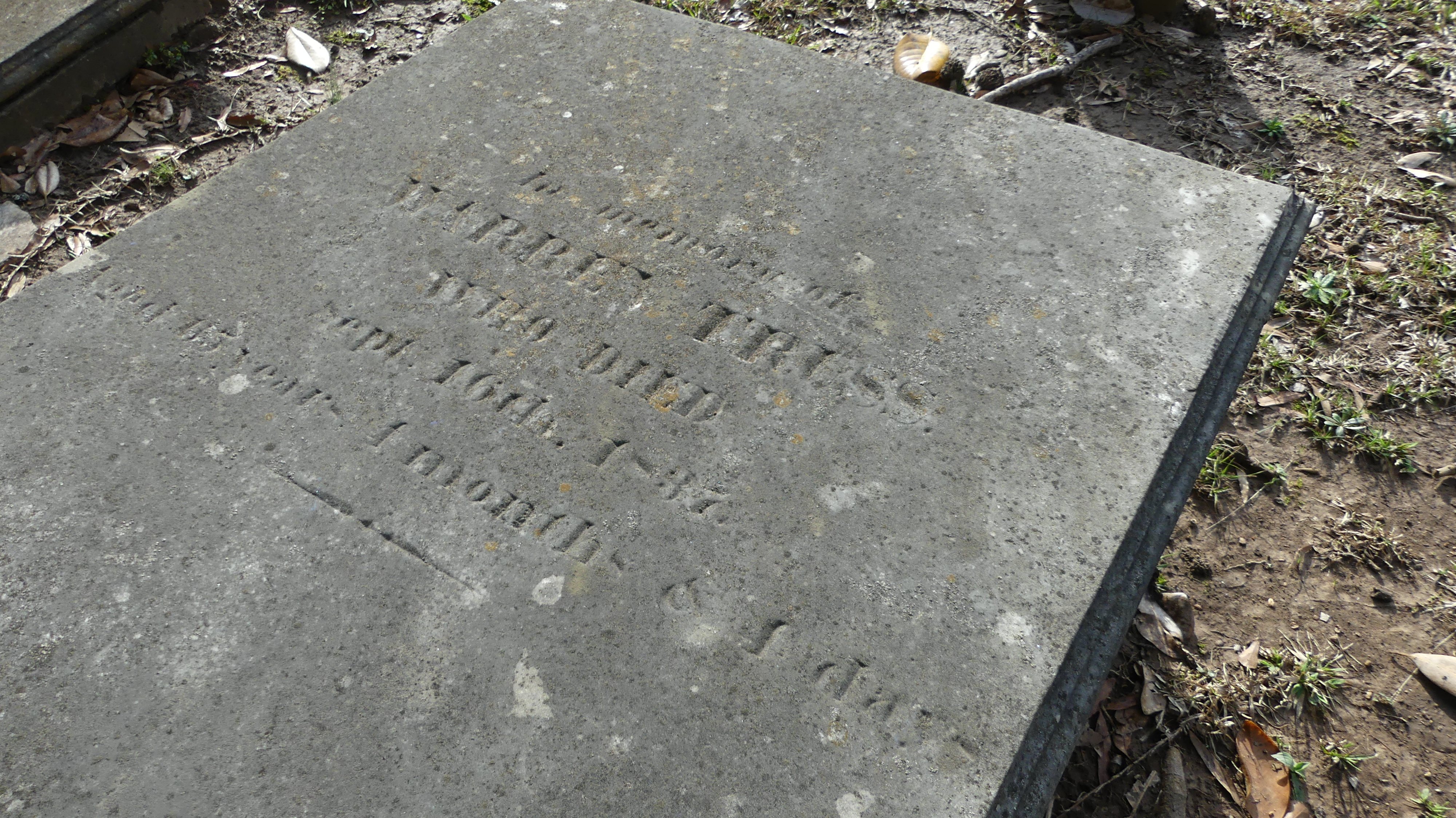
The last Truss deed on record in Pitt County, North Carolina, was signed by Warren Truss on October 2, 1817, so it appears evident that he left for Alabama sometime after this date. Warren Truss next appeared in St. Clair County, Alabama, in 1820, where he had a family of eight males, one female and seventeen slaves, according to the 1820 census of St. Clair County. Warren Truss’ children that appear in Alabama and contributed in part to the early development of Trussville and its surrounding area included Enos, John, Wiley, Arthur, Thomas K. Warren Jr., Susanna, Josiah, Samuel and Zilpha.
The area in which Warren Truss first settled is modern day Springville, located several miles north of Trussville. That region was named after a large spring located near where Joel and Samuel Truss, as well as numerous others, first settled. Within a few months, Warren Truss had decided to look for a home elsewhere, moving several miles southwest to the banks of the Cahaba River. Warren Truss first purchased land in Jefferson County on August 22-23, 1821. His land ownership in the county covered nearly 1,000 acres, apparently making him a wealthy man for the era. Warren Truss died on September 16, 1837.
Magnolia Tree
The centerpiece of the Trussville Memorial Cemetery is a huge magnolia tree that, as legend has it, was planted by a grieving young lover beside the grave of his intended bride. Overcome with the loss of his true love to pneumonia, the young man eventually grieved himself to death, and his family honored his request to be buried beside his sweetheart. It’s said that on a moonlit night, you can see the young couple embrace.
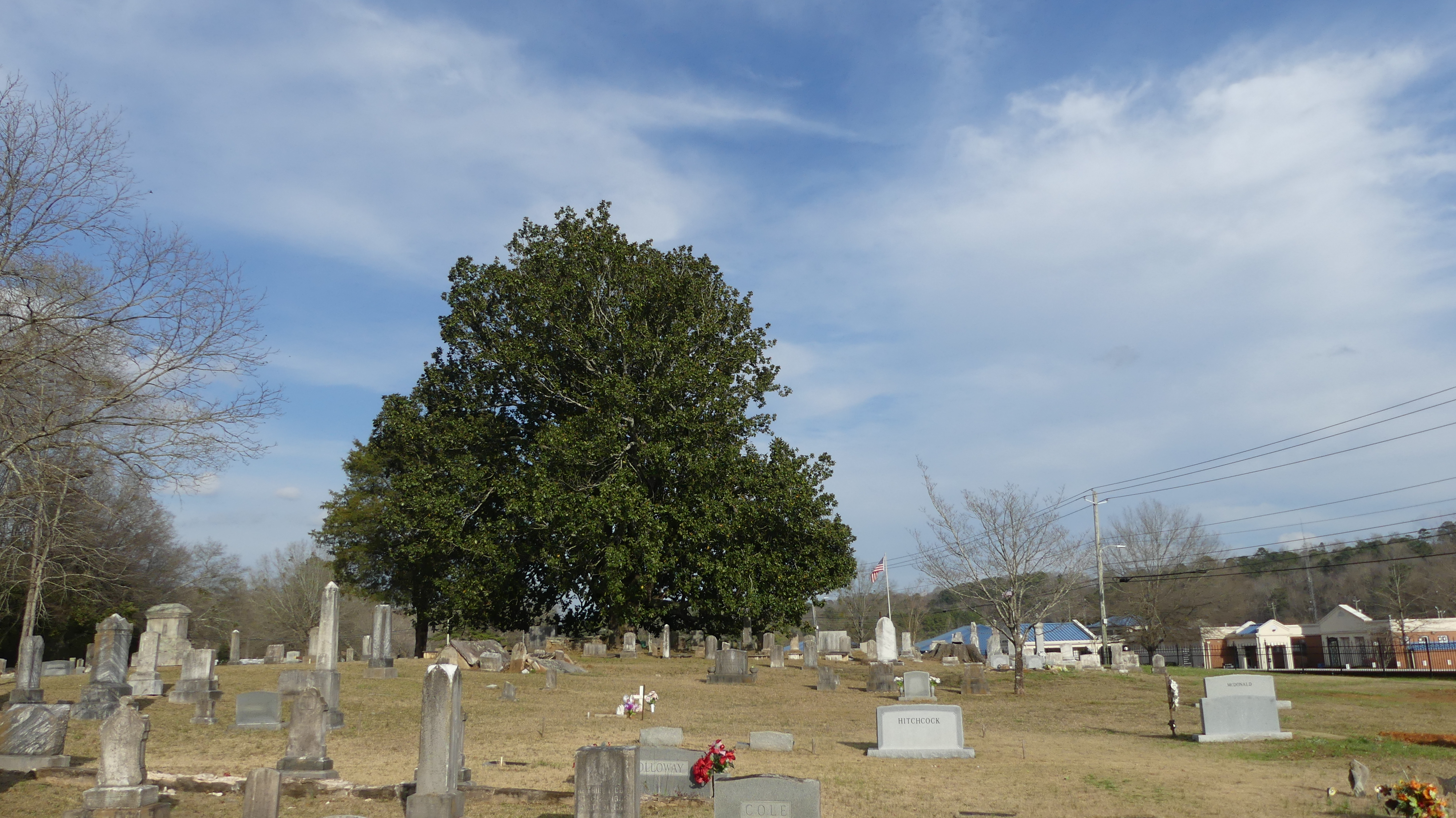
Formerly known as Cahawba Baptist Church Cemetery, it’s one of the oldest cemeteries in the state and serves as the resting place for many members of prominent Trussville families. Near the back entrance once stood Cahawba Baptist Church, though its front steps would have been located in what is now Main Street. There is a low spot that was thought to be filled with water, like a tiny pond, where baptisms took place.
Holly Tree
The tree is no longer here, but we’re trying to bring it back. The story of it says that soon after her husband’s accidental death in 1887 – a crowbar fell on his head in a well; how is this accidental? – Mary Carlisle rode to the cemetery on horseback to visit his grave. En route she pulled a shoot from a holly bush to use as a riding switch for her horse. Arriving at the cemetery, she stuck the shoot in the ground near her husband’s grave and forgot it.
The following spring, Carlisle returned to the cemetery for another graveside visit and found the holly shoot had rooted and was alive and growing. When she died in 1906, she, too, was buried near the holly tree, a symbol of her devotion.
[Main Street – jail, city hall, theater, etc. – on drive to Queenstown Lake]
Theater:

In the location of Regions Bank on Main Street there was once a movie theater. I believe it came in the 1940s.
City Hall and Jail:
On June 10, 1947, the Trussville area was incorporated as a town. The population at the time was 1,443 people. A month later, Horace Norrell was elected as the town’s first mayor. A graduate of Phillips High School, Norrell was the owner of Norrell’s Super Store in Trussville. Norrell was Trussville’s mayor through 1960. The first five aldermen to serve with Norrell were Mary Lou Farley, George A. Glenn, Alton Williams, John Yarbrough and Richard Beard. The initial police force was comprised of just two men, Police Chief Joe B. Vann and patrolman A.E. Quick. The mayor and five aldermen served in Trussville’s city hall building on Main Street, built in 1945. The city’s jail was located behind the building. The city’s second city hall building was built in 1949 on South Chalkville Road and was leased to the town for $100 per month. I forget which building each was, but I believe the Axe Downtown building was one at one time.
STOP 4: Queenstown Lake
Queenstown Lake:
The first inhabitants of this area were Indians. That history is hard to trace back, but what we do know is that there is a creek nearby called Stinking Creek, which means Trussville has a Stinking Creek and Pinchgut Creek. We sure know how to name them.
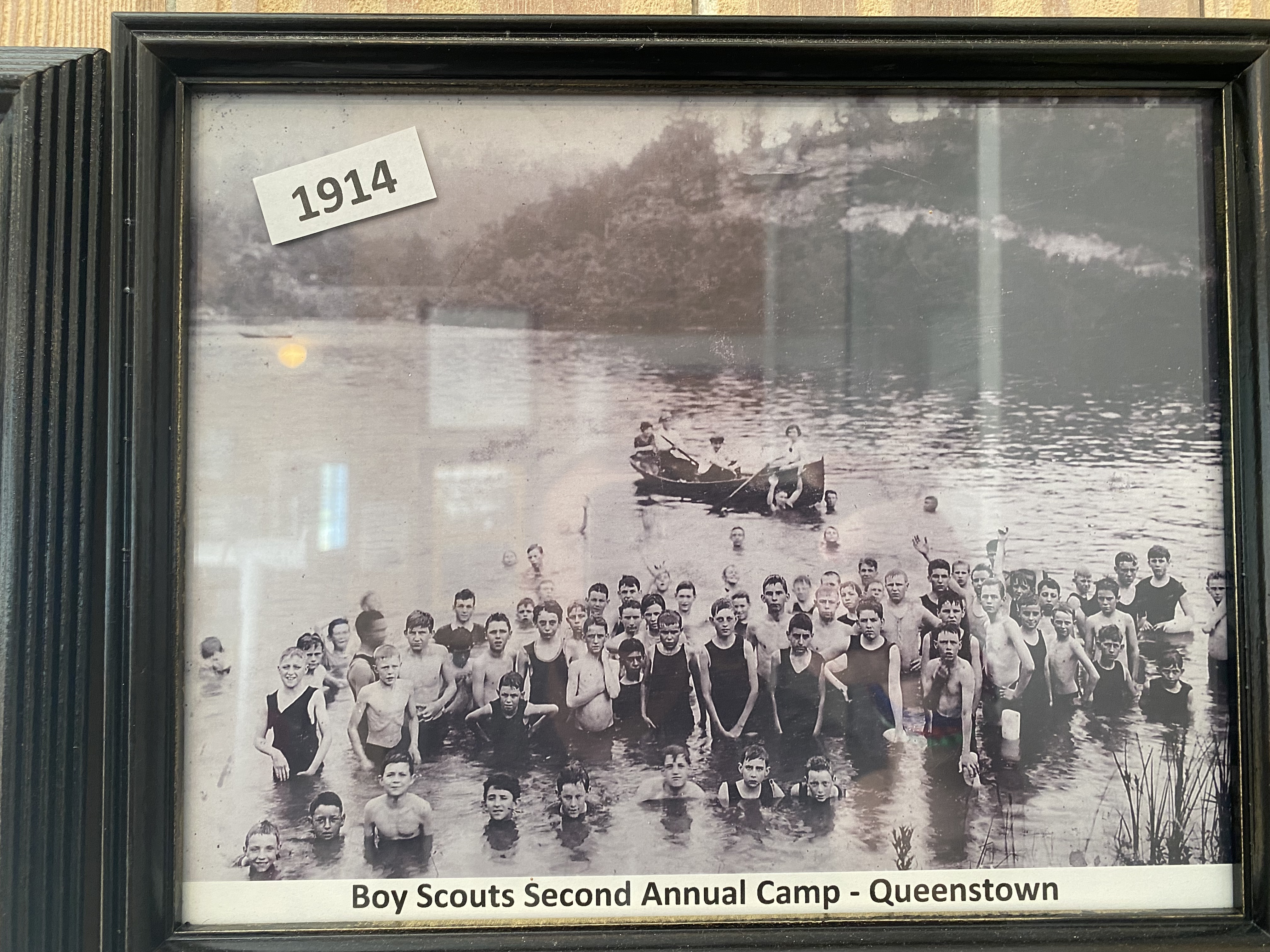
Anyway, Queenstown Lake was named so in 1909 after the Queenstown Development Company, which owned the property. Shortly after, B.O. Edwards bought the lake and surrounding land. He built cabins around the lake and rented them to visitors during the summer. It was a resort for folks from Birmingham who came on the train. The cabins were ultimately torn down during the Great Depression to save money on taxes, but Edwards continued to operate this recreational lake business for about 50 years, mostly for Sunday school picnics, family reunions, and company parties.
The 1920s and 1930s were the high points. The U.S. Coast Guard once trained here. There were recreational opportunities. The Howard College – Samford – football team trained here. A train derailed here that was supposedly carrying bombs for Vietnam War.
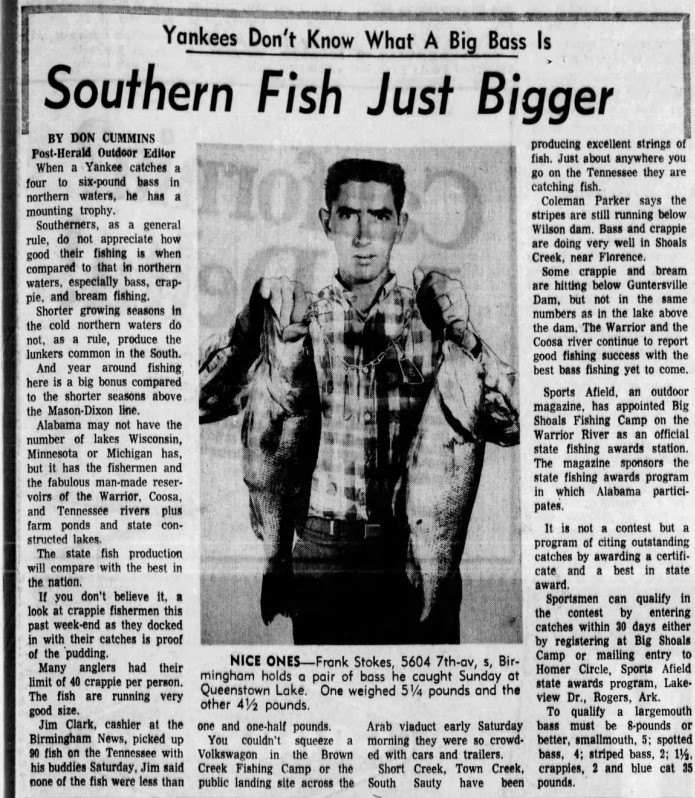

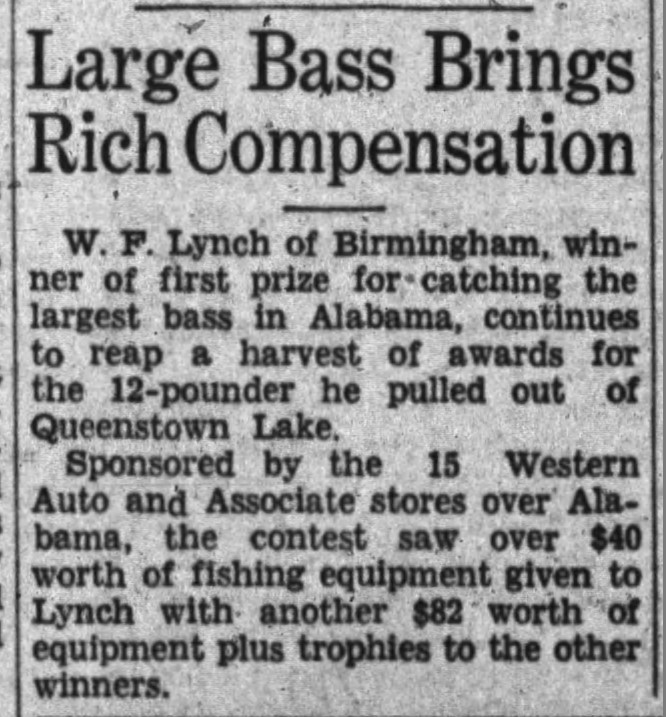
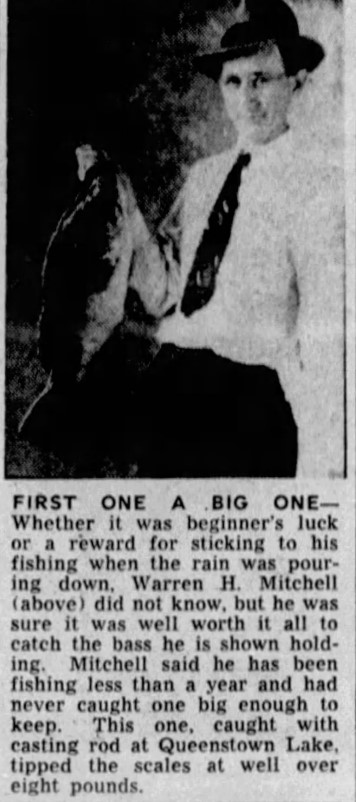
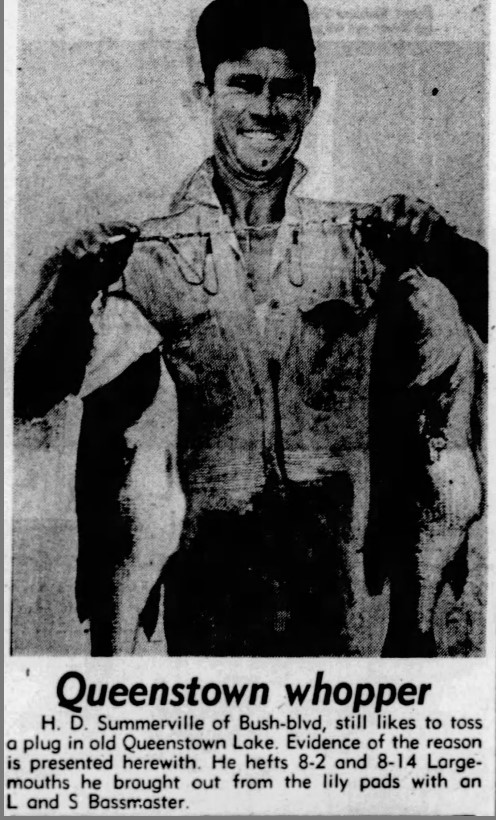
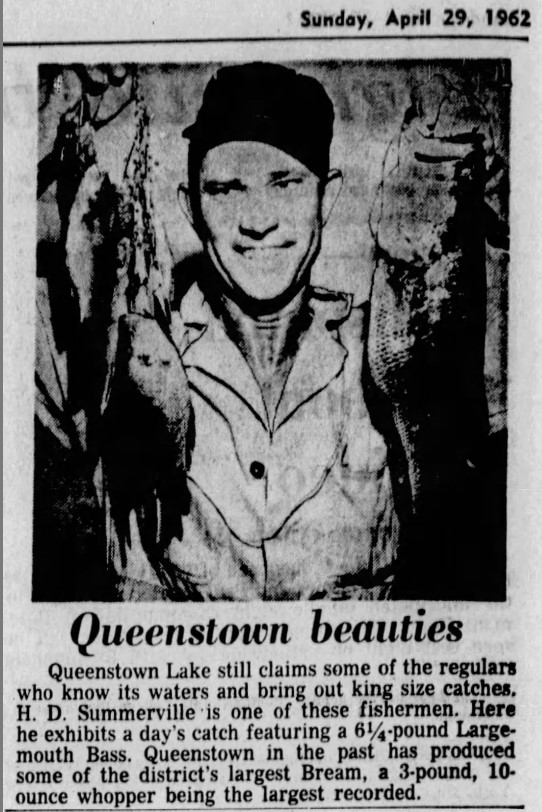


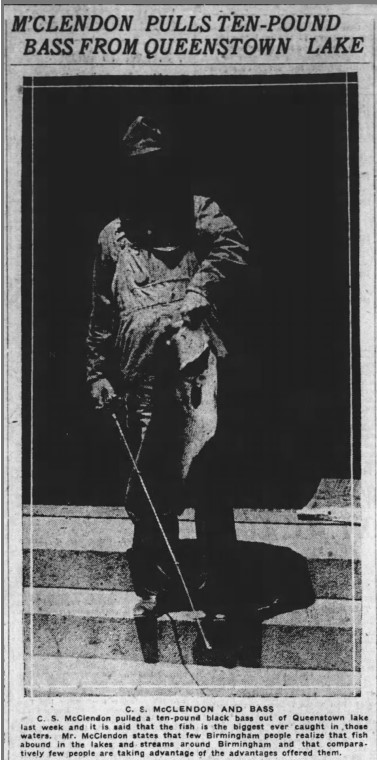
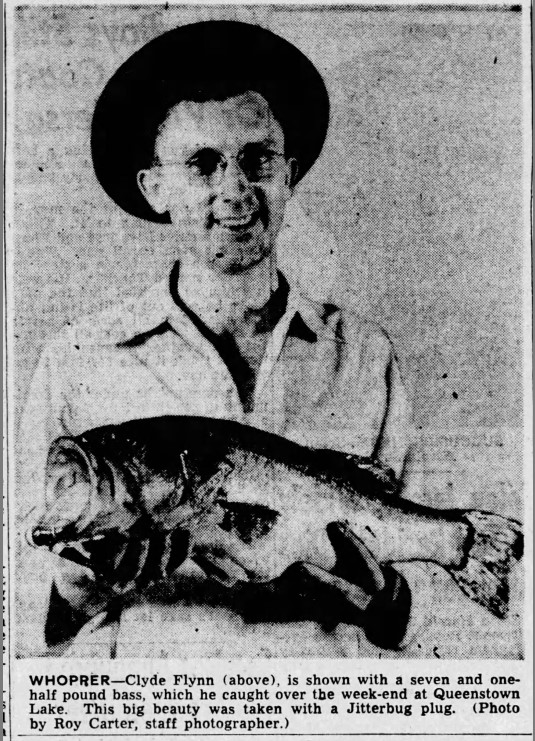
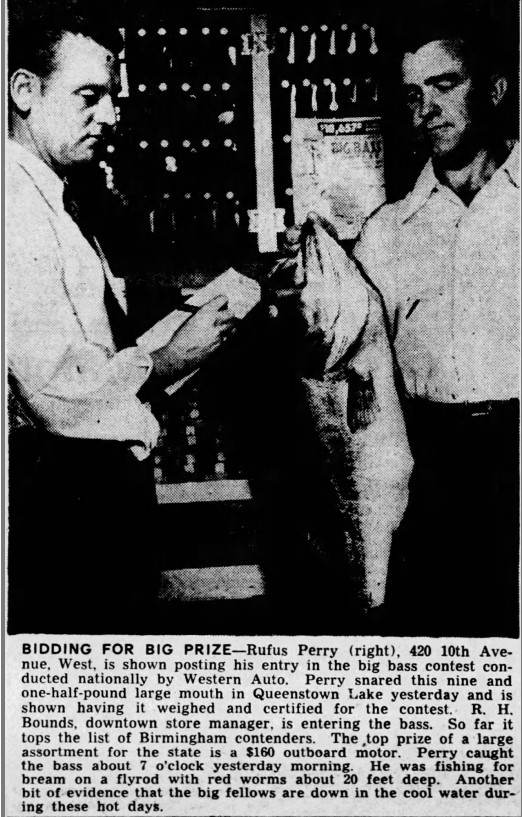

The 1930s through the 1950s were when it was its roughest. The dance hall on site – it was undergoing renovations earlier this year and I’ll likely be writing about next year – was converted to a honky tonk, one of the roughest in Jefferson County. Gambling, drinking, fighting, rumors of a murder, cars driving into ditches and ponds. The dance hall closed in the 1950s but the fishing continued. Some of the biggest fish I’ve ever seen came from this lake. The Gorrie family – Brasfield & Gorrie – bought it and it’s been owned by it since.
[Edwards House, Mt. Nebo, and more about Main St. – Mabe Power, Braden’s Furniture, on drive to City Hall Annex]
Edwards House:
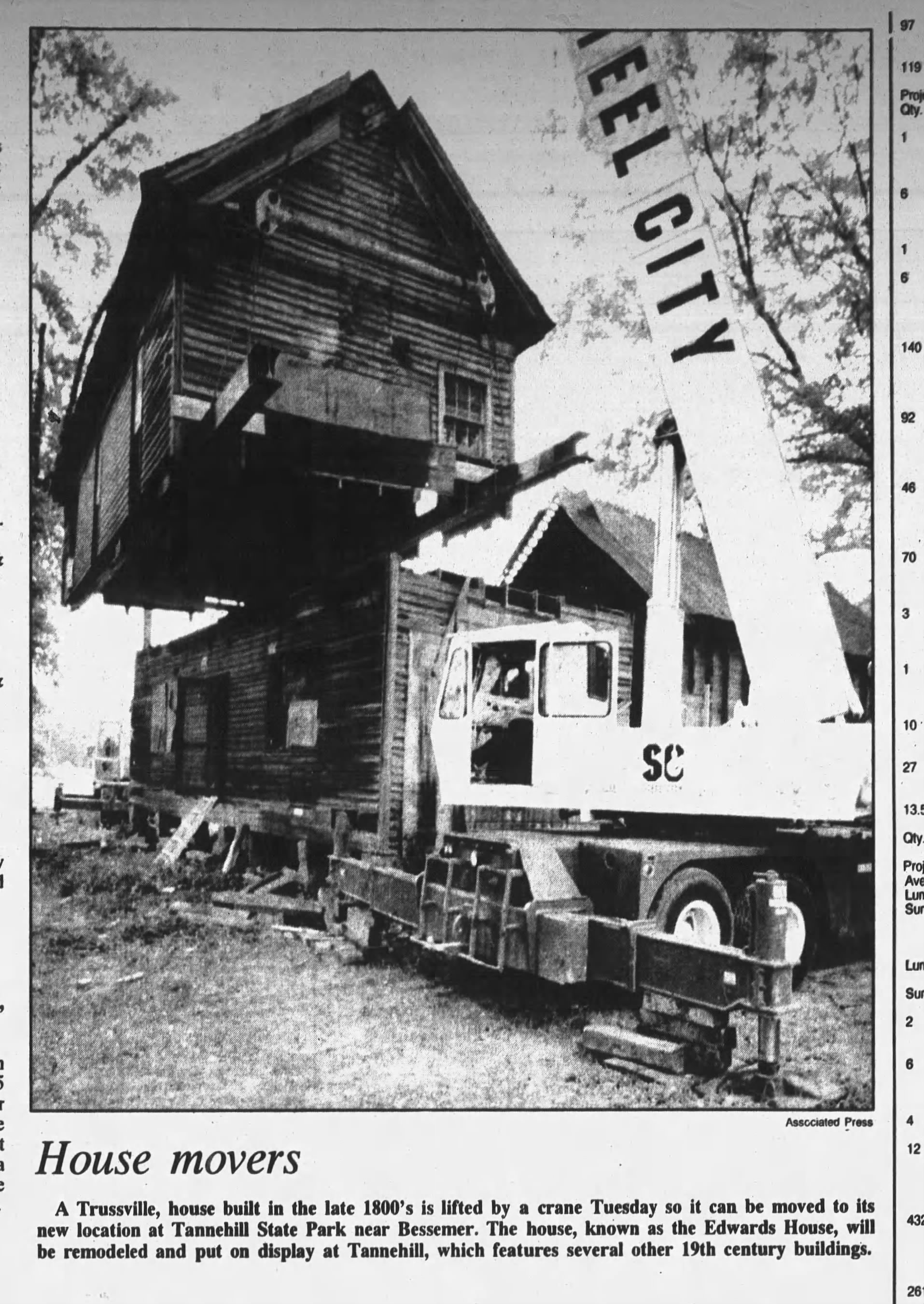
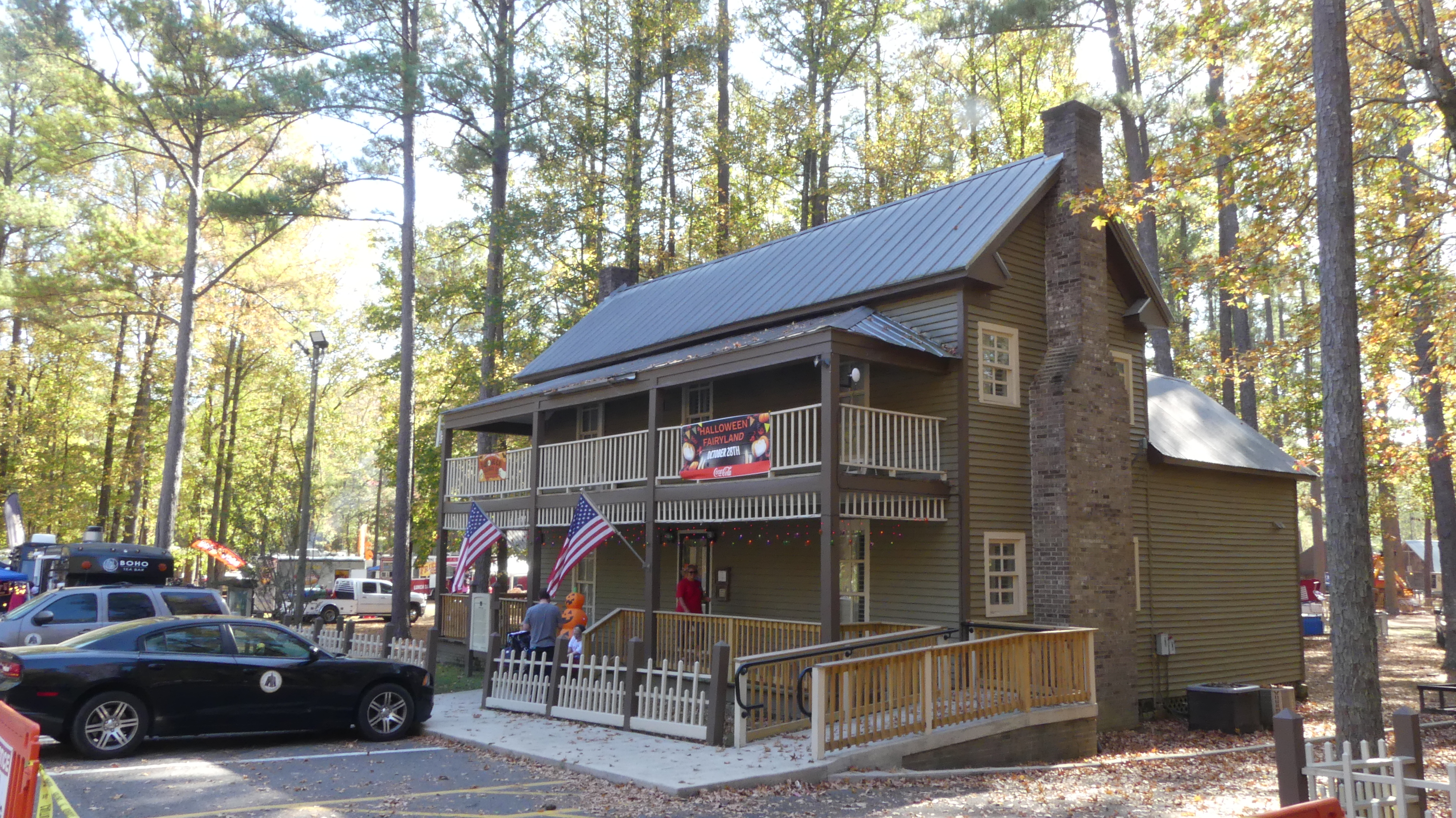
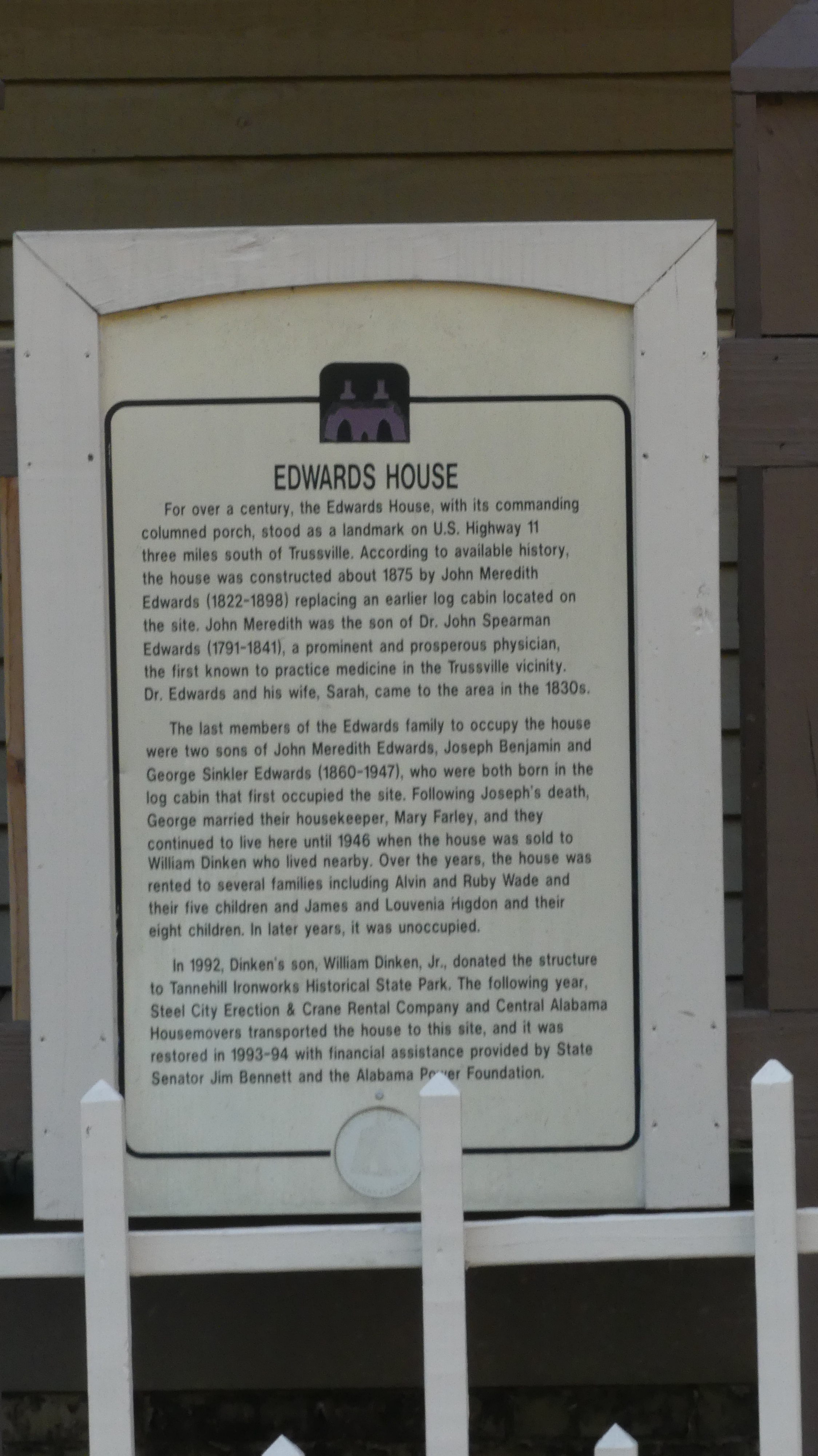
The Edwards House was built in the late 1800s, a two-story frame building supported by rock piers. It was located near where the former Bojangles and Freddy’s are today off Highway 11.
It was once the home of one of Trussville’s first physicians, Dr. John Spearman Edwards. The last members of the Edwards family to live in the house were George and Mary Edwards. The house and land by 1989 belonged to W.S. Dinken Jr. Tannehill Ironworks Historical State Park’s headquarters found a home in the 1879 Edwards House.
Abandoned for many years as a ghost house along Highway 11, it was moved into Tannehill in 1993 and fully restored. The two-story vernacular-style farmhouse also serves as a welcome center.
Mt. Nebo/First Presbyterian Church of Trussville:
The First Presbyterian Church of Trussville dates to October 2, 1867, when several people met at Sarah Talley’s residence for the purpose of organizing the Cave Springs congregation of the Cumberland Presbyterian Church. At the next meeting of the Presbytery of Springville, Alabama, Synod, the church’s name was changed to Montneba, or, Mt. Nebo.

The land on which the church was erected was given to the Presbyterians by Latham Linder for $1 in 1868, with the stipulation that it would be used for church purposes or revert to the donor or his heirs. Adjoining land was given to a masonic organization and a frame house costing $175 was built to be jointly occupied by the masons and the church congregation. The frame house served the congregation until 1899, when it was demolished, and the present-day structure was built nearby. On October 25, 1958, the congregation changed the church’s name from Mt. Nebo Presbyterian Church to First Presbyterian Church of Trussville, which it remains today.
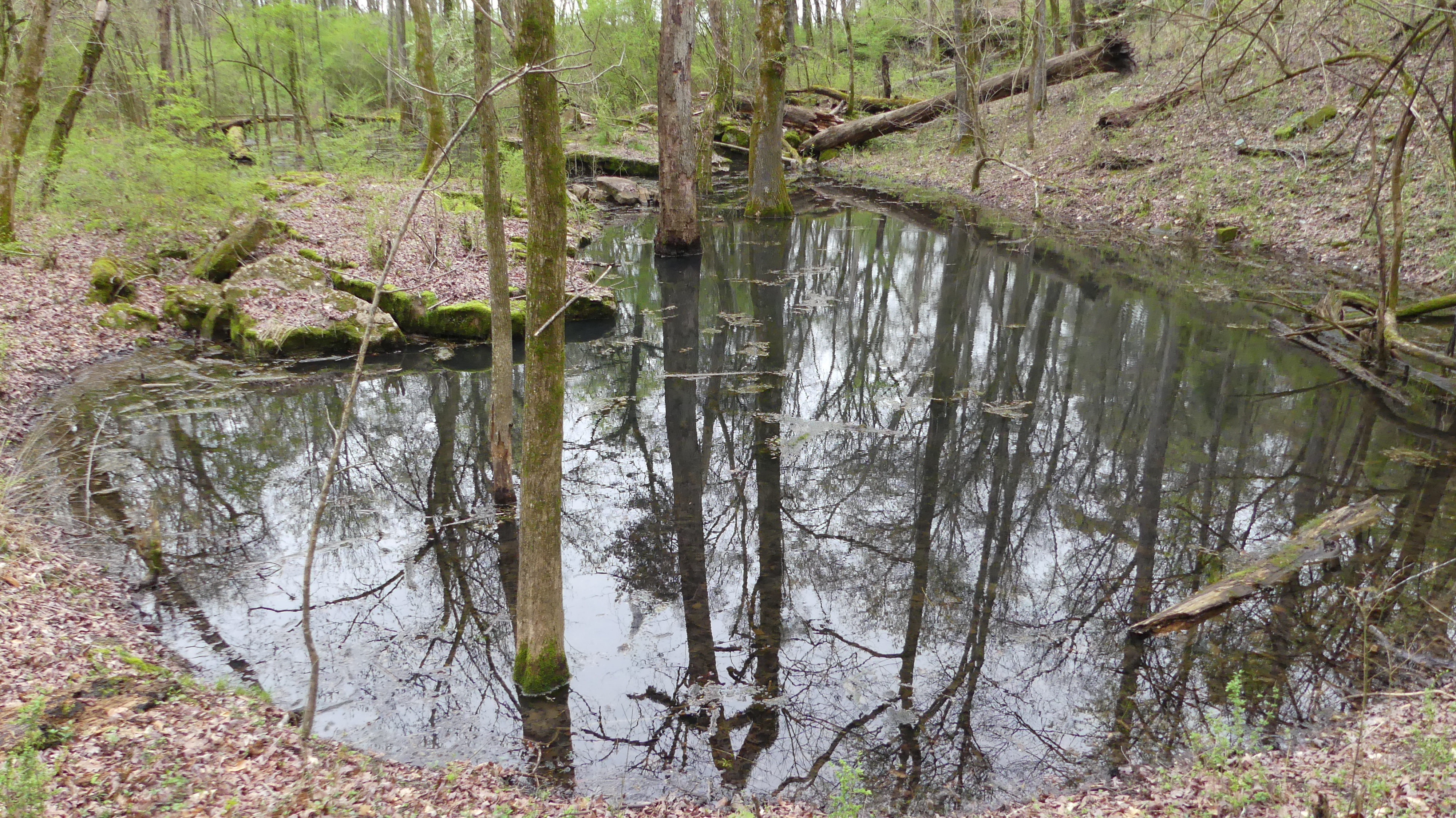
And, if you’re adventurous and curious, that Cave Springs name isn’t by chance. There is a cave behind the church in the woods. I’m not sure how accessible the actual cave is today, but I have been near it. There are many stories about it, even as late as the late 1800s.
Mt. Nebo Cemetery is located directly across U.S. Highway 11 from Trussville First Presbyterian Church. A historical marker that was once located near the church suggests that the cemetery was founded in 1860, seven years before the church was founded. Some grave sites here are marked only by rocks. It was listed in 2021 by the Alabama Historic Cemetery Register as a historic cemetery.
Mabe Power / Braden’s Furniture / Civil War Storehouse:
Mabe Power and Equipment Center, prior to its closing in 2012, was the longest continuously operating business in the city of Trussville. It’s now a Keller Williams Realty office. With the invention of the automobile came service and mechanic stations in the early 1900s. Bill Mabe opened a garage in Trussville in February 1921, where automobiles were services and repaired. A generator there also provided electricity for customers in Trussville for $1 per month for each bulb.

In the 1930s, the station was remodeled and operated as Bill Mabe’s One Stop Service Station, when gasoline for automobiles cost motorists fewer than 20 cents per gallon. John Mabe, Bill’s son, ran the station as well, which eventually became known as Mabe Garage and Lawnmower Repair.
That name was changed to Mabe Power and Equipment Center in 1990 because the business was no longer servicing and repairing automobiles, only lawn equipment such as lawnmowers, weed trimmers and chainsaws. Kathy Mabe Kennedy, John’s daughter, owned the business from 2007 to its close on April 30, 2012, a decision based on family reasons, a 2003 flood that caused extensive damage to the Main Street business district and three consecutive years of drought. At the time of its closing, the Mabe business had been open for 91 years and run by three generations of Mabes.
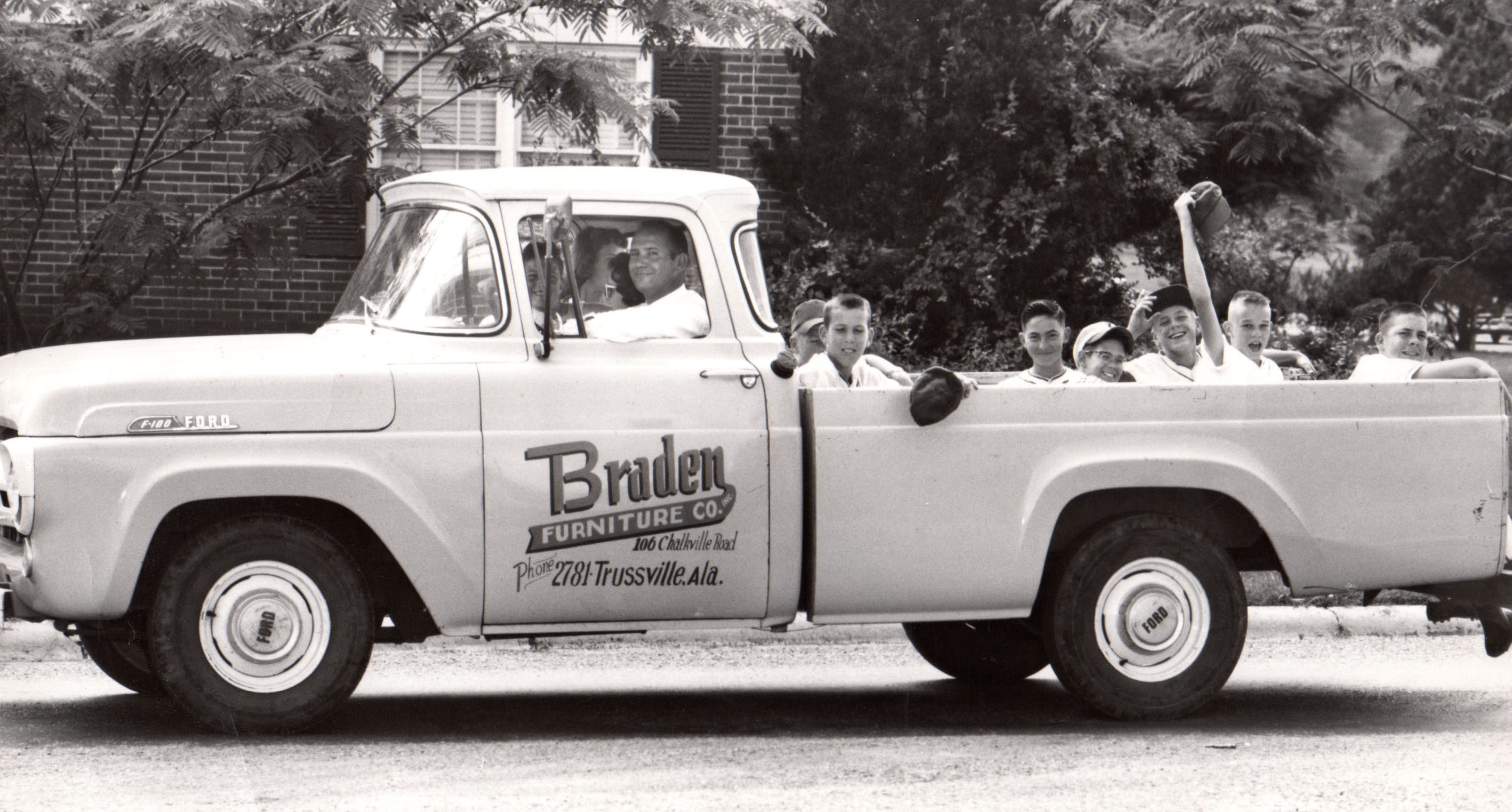
Braden’s Furniture, now the Cahaba Building, was located at the corner of Main Street and North Chalkville Road. The furniture store was founded in 1956 by Vernon and Kathleen Braden. In 1974, their son, Billy Braden, joined the company.
Billy Braden bought the company from his father in 1989 and doubled the store’s size. Braden’s Furniture remained open until its closing in 2014. Several of the buildings that made up Braden’s Furniture were demolished in 2019, at which point plans for The Cahaba Building began.
Civil War Storehouse:
That street corner has a long, rich history. Before the Civil War began, Trussville was one of the most prosperous agricultural communities in the northern half of Alabama. When the war started, 10% of all meat, corn and wheat in storage or raised was taken by the Confederate government for support of its army and navy. The tenth taken was designated as a war tax, and was set aside for government use, amassed in a stone storehouse that had been converted into a warehouse for these supplies.

Its location?
The modern-day corner where The Cahaba Building is now located. The warehouse, which belonged to Captain Thomas Truss and Marcus Worthington, was well filled with supplies when, on April 20, 1865, General James H. Wilson and a brigade of Federal soldiers came through. The Federals took all they could and attempted to burn the storehouse. The stench of burning wheat and ham was stifling, though most of the wheat was salvaged and ground into flour.
Later, T.E. Glenn General Merchandise store was built on that corner. It was lost to fire in September 1938 and T.E. Glenn’s Department Store replaced it. Then Braden’s came after that.
STOP 5: Hewitt High School/Hewitt Elementary School
Park at Trussville City Hall Annex
Hewitt High School/Hewitt Elementary School
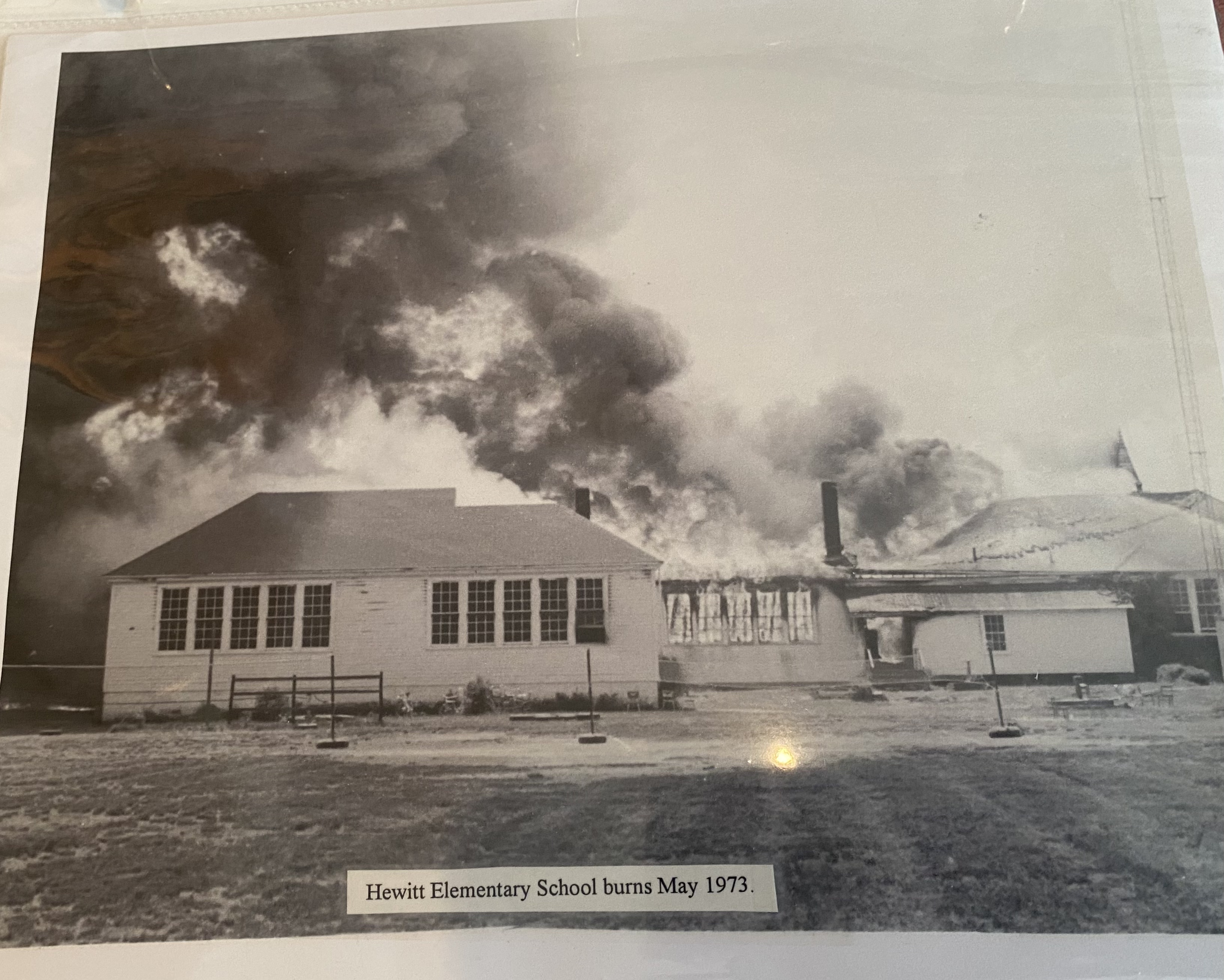
On May 10, 1973, Trussville children were sent running out of a 51-year-old building by orange flames and black smoke. Hewitt Elementary School, the one located on North Chalkville Road near the former Trussville City Schools Central Office, caught fire around 11:30 a.m. that Thursday. The fire apparently started in the center of the building and spread throughout the wood-and-brick building within seconds.
The cause of the fire remains a talking point today. Oiled wooden floors? Kids with matches? Something wrong with the lights?
Miraculously, not one of the nearly 600 fourth-, fifth- and sixth-graders was injured. Perhaps the biggest losses that day were 937,000 bottle caps that students had collected (the goal was one million), library books and many of those yearbooks. The ordeal was such a big moment that the Trussville History Museum at Heritage Hall features articles, photos and even a printed collection of student comments about the fire.
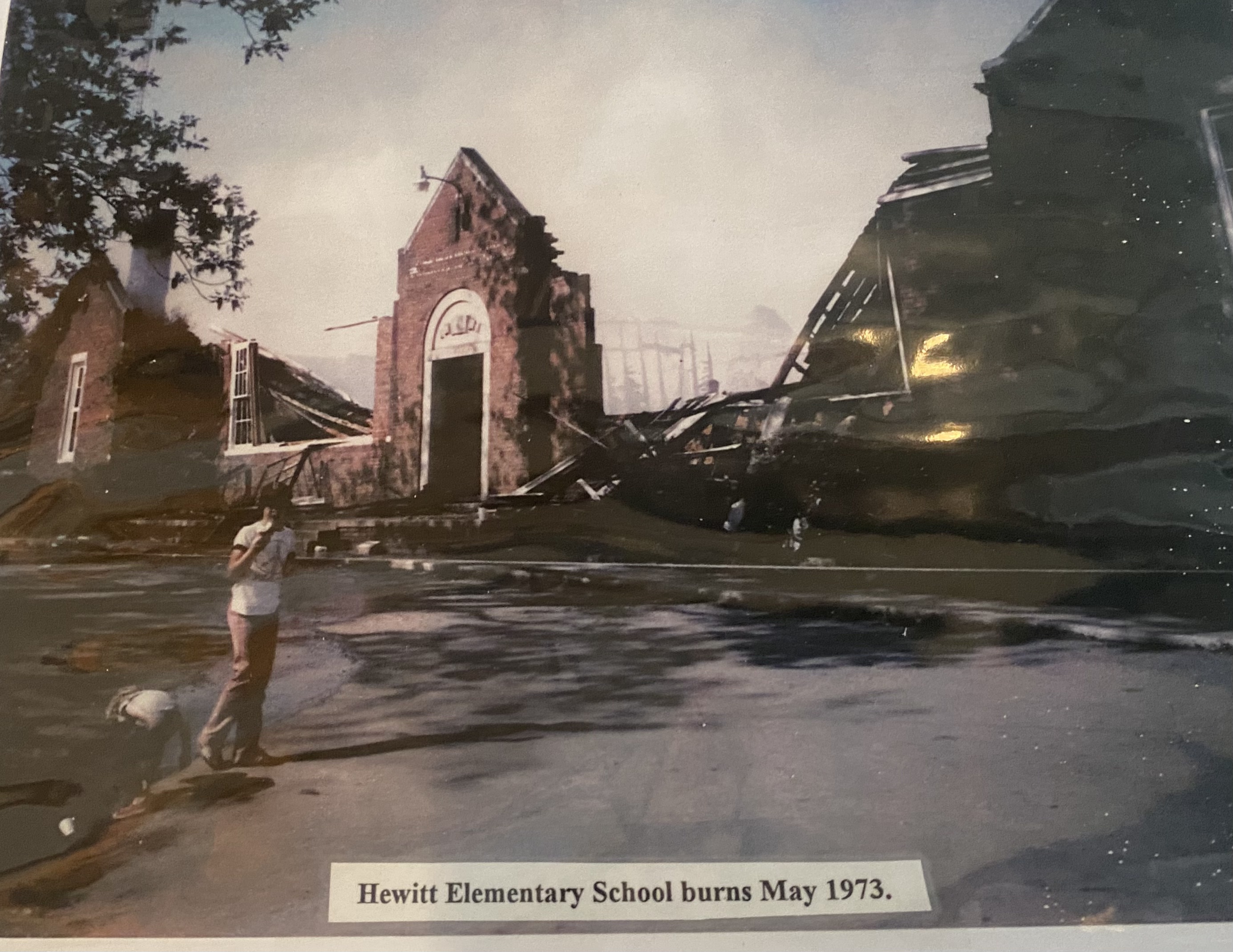
That building had served as Trussville School from 1922 to 1926, R.G. Hewitt High School from 1925 to 1938 and then Hewitt Elementary School from 1938 to 1973. It included a concrete lintel over the school’s double doors, which came down in the fire but was salvaged years later and is now preserved, more than 100 years since its creation.
For the remainder of that school year, classes took place in the Trussville Methodist Church and the nearby former First National Bank building. Portable classrooms were used for the 1973 fall term until additions could be made to the annex school on Cherokee Drive, which became the only elementary school in the city at the time.
STOP 6: Cahaba Project
Park along South Mall and can discuss all these and walk to Heritage Hall last
- Cahaba Project homes/history
- Blast Furnace/Birmingham Mineral Railroad
- Heritage Hall
Cahaba Project/Homes
The stock market crash of October 29, 1929, and the ensuing Great Depression sent shockwaves throughout the United States and world. The Great Depression devastatingly affected rich and poor countries, cities and people. The presidential election of 1932, between Republican incumbent Herbert Hoover and Democratic nominee Franklin D. Roosevelt of New York, was the beginning of change for the nation, and for Trussville. Roosevelt won the election largely due to his optimistic personality.
Roosevelt’s New Deal was a series of economic programs enacted between 1933 and 1936, focusing on relief, recovery and reform as part of progressing from the Great Depression. The programs centered on relief for the unemployed and poor, recovery of the economy and reform of the financial system to prevent another depression.
During the Great Depression years, the federal government was attempting to relieve many citizens in the low income bracket. The idea of developing homesteads with a moderate amount of acreage was considered and later pursued throughout the United States. In Jefferson County, a committee of prominent local citizens selected a site in Trussville in plain view of the slagheap from the dismantled furnace, giving the homestead project the name “Slagheap Village,” later to be known as “Cahaba Village” and “The Project.”

Senator John H. Bankhead and Dr. M.L. WIlson accompanied the trio on its inspection trip to Trussville, where it became apparent that the property would not be suitable for a homestead development. Resettlement Administrator Dr. Rexwell Tugwell came to the area on an inspection trip. The area included 30 houses for whites and 40 houses for blacks, part of the housing formerly connected to the furnace. Tugwell and his associates decided to provide homes in the area not for homestead operation or for victims of the Great Depression, but for a quality suburban residential development. Being tired of fancy names for these developments, Tugwell declared the project to be called “Slagheap Village,” since a mountain of slag from the furnace was still visible. It was later called “Cahaba Village,” after the nearby Cahaba River. Prior to the land being purchased and the homes constructed, though, the residing families had to be relocated. The black families were moved to a project site called The Forties, an area still in Trussville today, perched atop Valley Road near the Tiffany Estates subdivision.
At Tugwell’s suggestion, W.H. Kessler drew up the layout plans for the project and was from thereafter called “town planner.” Cahaba Village consisted of 287 residential units — 243 homes and 44 duplex unites, constructed from 1936 to 1938 at an overall cost of $2,661,981.26. The total cost included work on public utilities, streets, curbs, gutters, and public buildings comprising the high school, community building and co-operative store. The acreage cost was not included. Skirting the housing development was a green stretch of properties designated as park areas to protect the encroachment of any development that may detract from the beauty of the community. The properties took two years to construct and were opened in April 1938. A waterworks, sewage disposal plant, paved and lighted streets, and some sidewalks were provided.
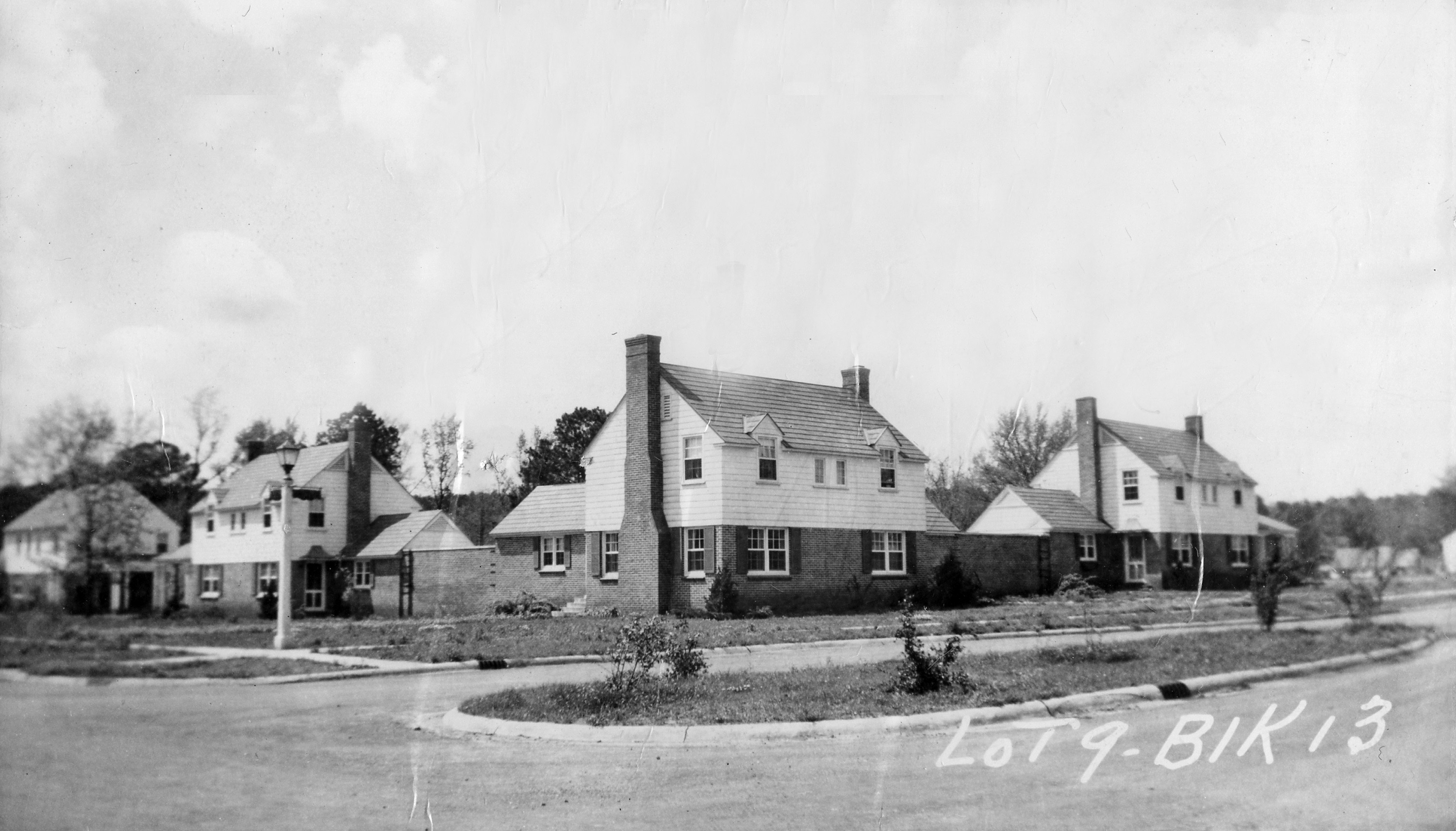
A March 11, 1947, letter from the Federal Public Housing Authority briefly outlined the proposed incorporation of the town of Trussville. The letter states that the Cahaba Project is a fine example of planning for semi-subsistence homes that would be protected from the uncontrolled growth of its neighbor, Trussville. Two Cahaba Project streets, Chalkville Road and Parkway Drive, connected with Trussville, and all border lots in the Cahaba Project were arranged so that they faced away from Trussville. All minor streets had been planned that their connections with Trussville were made by way of Chalkville Road or Parkway Drive.
“The time has come now to join these separate communities as an Incorporated Town,” the letter states. “In order to do so there must be more direct connections between the two communities and a pooling of their interests so that a well organized community will be attained.”
On June 2, 1947, an election was held to determine whether to incorporate the town of Trussville into a city form of government. The election carried and all property owned by the Federal Public Housing Authority with four legal voters per 40 acres of land was included in the area to be incorporated. Cahaba Village was absorbed into the town of Trussville when it was incorporated on June 10, 1947.
By July 21, 1947, an election of a mayor and five aldermen was held. Horace Norell was elected mayor, and elected as aldermen were Mary Lou Farley, George A. Glenn, Alton Williams, John Yarbrough and Richard Beard.
Blast Furnace
The most significant addition to Trussville by 1870 during the Reconstruction era was the railroad, which reached Trussville in 1870. The Alabama and Chattanooga Railroad Company completed its 295-mile project from Chattanooga, Tennessee, to Meridian, Mississippi, in 1870-1871. The railroad addition to Trussville meant more jobs for residents. The trains that passed through brought regular mail, freight shipments and passengers from the eastern United States. It also meant more industry in the 1880s.
March 19, 1884 — The Birmingham Mineral Railroad received its certificate of incorporation to begin operations. Did you know that it used to run right here in front of the school on Parkway Drive?
Dec. 21, 1886 – The Birmingham Furnace and Manufacturing Company was incorporated by a group of men from Uniontown, Pennsylvania. The first land company was the Trussville and Cahaba River Land Company, which incorporated on March 19, 1887. That same year, a tract of land was purchased from the Trussville and Cahaba River Land Company, and construction of a furnace began. A large portion of the furnace built that year came from material from the dismantled Lemont Furnace in Fayette County, Pennsylvania. The furnace was located on the land where the historic school on Parkway Drive is now located. It was 65 feet tall!

April 8, 1889 – The Trussville furnace was blown in for the first time! The furnace remained in blast until the middle of 1893, when it was blown out due to the low demand for pig iron.
1896 – The furnace was put back in blast by the Trussville Furnace Company. It only ran a few months. Transportation cost was too high.
1899 – The Trussville Furnace, Mining and Manufacturing Company took it over on Sept. 1, but it wasn’t back running until 1901 and again only operated a few months.
July 10, 1902 – The Lacey Buek Iron Company purchased the furnace, which was rebuilt and expanded to 80 feet tall from 65 feet tall. They began running it in 1903 and called it the “Ella.” It ran under this company for 3 years.
July 1, 1906 – The Southern Steel Company, which rebuilt the furnace but did not enlarge it, takes over. There were 212 workmans’ houses attached to the plant, and in 1907, the Southern Steel Company bankrupted. The Southern Iron and Steel Company acquired the furnace in 1909, but it was blown out in 1910. This company defaulted on its bonds in 1911 and the furnace was passed to the Michigan Trust Company.
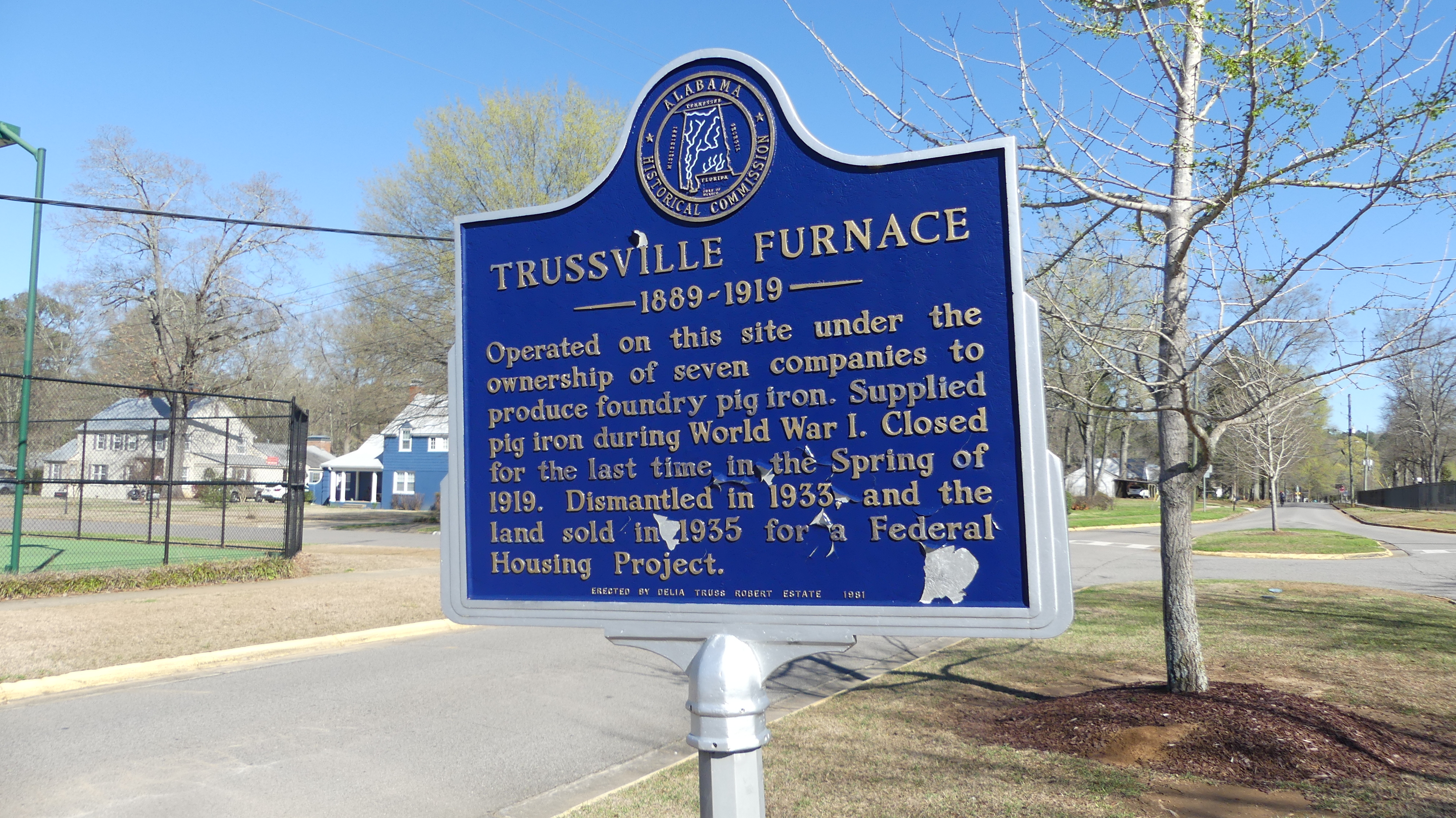
1910 – 1917 – The furnace was idle, not working. The Birmingham Trussville Iron Company was organized, taking control of the furnace. The furnace was blown in for the final time in the spring of 1918, operating until the spring of 1919. The furnace remained abandoned until its dismantling in 1933.
April or May 1933 — Gate City Branch from Ruffner Mountain Ore Mine No. 2 to Trussville of the Birmingham-Mineral Railroad was abandoned.
Heritage Hall
Just beyond the east side of The Mall beside the New Deal-era school building is Heritage Hall, originally a retail general store and filling station managed by the Cahaba Cooperative Association. Built in 1938 along with the homes in the Cahaba Project, the store served the needs of the Cahaba Project residents. In 1951, four years after Trussville incorporated as a town, the town bought the general store to establish a community center and library. It later served as band and choral rooms for the high school.
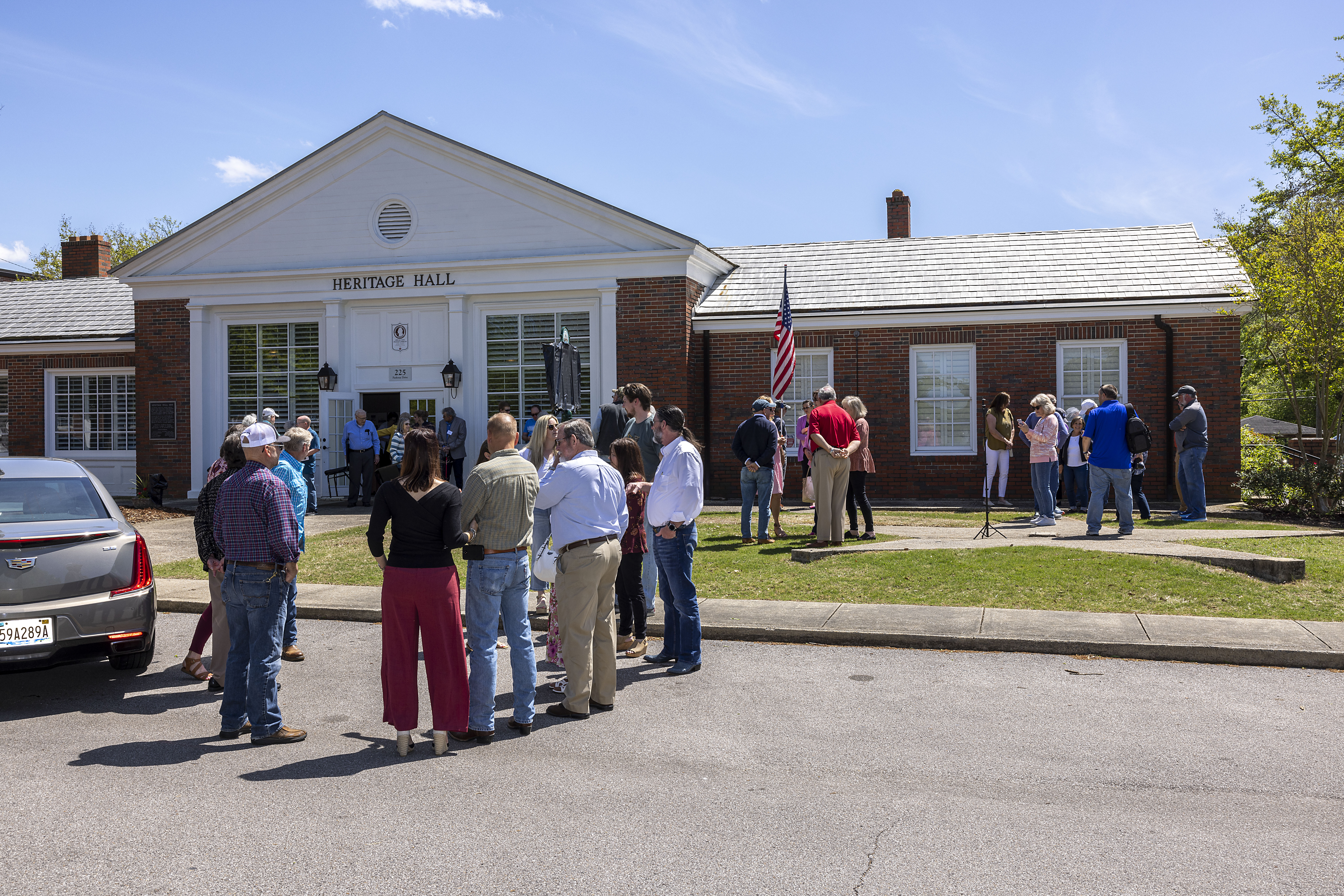
In 1988, on the building’s 50th anniversary, the Trussville Industrial Development Board restored the building. The building was dedicated to the preservation and development of the historic, civic and cultural heritage of the city through the Trussville Historical Board, the Trussville Area Chamber of Commerce and the Arts Council of the Trussville Area. The Trussville Chamber of Commerce had existed since 1946 but did not have a permanent office until the restoration in 1988. The left side of Heritage Hall holds old yearbooks, newspaper articles, books, artifacts, photos, and other historical findings relative to the city of Trussville. The backside of Heritage Hall, near the Trussville City Pool, is ACTA Theatre, where local students and residents participate in dramas, comedies, and musicals.
 Gary Lloyd Books