Tag: writing

Pitches and promises

The sophomore pitcher circled the mound before the first batter stepped into the box, and then he bent over behind the rubber. He extended his left hand and began to use his index finger as a pencil for the cool dirt. It was winter, and the high school baseball season was just underway. He was set to face his high school’s arch rival, one of the best teams in the state of Alabama. The sophomore had already won his first three starts as a varsity pitcher, including a five-inning no-hitter, striking out nine batters in a shortened game due to the mercy rule. He was an ace. But against his team’s rival, he should have been nervous. He was a sixteen-year-old pitching against a great team, after all. But he was as cool as he could be. He was pitching with purpose.

GET VALLEY ROAD: UPLIFTING STORIES FROM DOWN SOUTH HERE

Not long before the game, he stood in his coach’s office in the stadium’s press box, and talked about his purpose with a reporter. His mother died the previous October after battling breast cancer for nearly two years. The family found out about her diagnosis on Valentine’s Day when the sophomore was an eighth-grader, in the drive-thru at a Wendy’s. When she died, his mother was fifty years old. Just before she died, her son promised her two things — that he would marry a woman who reflected her and that he would pitch his way to college baseball.

“When people lose family members, some rarely get the opportunity to talk with them and say goodbye,” he says. “Barring the situation, I feel really thankful I was able to do that. When my mom was on hospice care, I got to be around her a lot. While she wasn’t very responsive, you could tell when she was hearing and listening to you. I got the chance to tell my mom how thankful I was to have her as my mom, and she taught me more (about) life than she would ever know. Getting to tell the person who gave you everything in life how thankful you are for it and how much you love them for the sacrifices they gave to benefit your life is something that will give you peace to any situation. I also promised her things in life that I would accomplish for her – in memory of her.”

He left the press box after a fifteen-minute interview and warmed up for the game. Just prior to the first pitch, he bent down to etch his mother’s initials and the breast cancer symbol on the backside of the pitcher’s mound. He proceeded to hurl a complete-game five-hitter, allowing his only two earned runs in the top of the seventh, the final inning. His team won 3-2. He struck out six batters. He finished his first varsity season with nine wins and one loss for a team that won the area championship.

“The support I had from my baseball team that season was something that was beyond special,” he says. “I felt so close to all those guys and I knew they were behind me supporting me through that time.”

His head coach that season was supportive. After the win over the team’s biggest rival, the coach talked about how his pitcher’s tough situation ministered to his team, how instead of the team ministering to him, his family ministered to the team. He called it amazing.

Over his final two seasons of high school baseball, the pitcher compiled twelve wins against just four losses and a 1.88 earned-run average. He struck out more than one hundred batters.

For his efforts, he earned scholarship offers from several college programs around the Southeast. He chose the one closest to home, to be near his longtime girlfriend and son, who was born when he was a high school junior. His plan was to propose to his girlfriend during one of his college baseball seasons. He did so on the first weekend of the 2017 college baseball season. She said yes.

“I feel like it is a promise kept, and I am blessed to be in the situation I am in,” he says. “I will always look back to my coaches and teammates during the hardest time in my life and see the positive impact they had on my life, and where I am now is because of all they did for me during this time in my life.”

As far as his mound ritual, the pitcher no longer etches his mother’s initials in the mound, but they are written across his glove, so that she will always be there for him every time he steps on a mound. He looks back to that sophomore season as a blessed time.

“Going through things like that will always be hard, but when you have people surrounding you and providing love and encouragement, it gives you a peace about it,” he says.
The piano man

A chapter from “Valley Road: Uplifting Stories from Down South”by Gary Lloyd, complete with video of the man playing the piano:

As long as I have known him, he has played the piano.

At Christmas, Mr. Darby would play “Jingle Bells” and “Santa Claus Is Coming To Town” at my grandmother’s house. He could have played professionally, and there is no doubt about that.

When I moved into my grandmother’s old house not far from Trussville, Alabama, the brown Wurlitzer piano remained. Its top held framed engagement and wedding photos, and its bench often acted as a resting place for bills and other mail. I never played, but there was a time, when my wife and I lived there, that Jessica would sit down on that piano bench and play. Our dog, Abby, sat with her.

When we moved out, the piano again remained. It stayed when a family friend moved in, and after he left. It has stayed since my mother-in-law moved into the house. She likes the piano there, and so do I. It provides a glimpse into the past.

The man who tickled those ivories for so many years is in his nineties now and has lived in a retirement community for a number of years. He has battled severe dementia. When he has called my parents’ house and spoken to me, he has believed I am actually my dad. When I have visited him at the retirement community, he has asked the same questions over and over. He doesn’t remember asking them the first time. Each time, I just answer him, as if it is the first time he’s asked.

This retirement community has a spacious lobby area, almost like a huge living room. There are couches, women at tables playing card games, and a huge, glass case filled with fluttering birds.

There is also a piano.

We visited the Piano Man on September 1, 2014, to see him for his birthday, which was the following week. Mr. Darby wore gray slacks and a teal sweater, and I wondered how in the world people can wear sweaters in September in Alabama.

Somehow, we convinced him to sit down at the piano and play. I wondered how he would know what to play, how he would remember which keys to press. He sat down, and muscle memory took over. He played “It Had To Be You,” not messing up a single time in a video recording that lasted one minute and four seconds. I couldn’t believe that a man who often forgot my name could do this. It was remarkable.

Elderly women stopped dealing cards. Men, aided by their walkers, came to sit closer. The staff looked on. Everyone clapped. Mr. Darby’s cheeks reddened.

That song has been recorded by famous surnames such as Sinatra, Holiday, Charles, Bennett and Stewart.

Call me biased, but I would add Darby to the top of that list.

Some positive news from Atlanta

I went to Atlanta this weekend, and if you perused the Georgia headlines, you would have seen this:

A Gainesville, Ga., man was charged with molesting an eleven-year-old girl. 

A man was shot outside of a Krispy Kreme.

A middle school student brought a gun to school and showed it to classmates. 

A man fired a shot into the air after a disagreement with his Uber driver. 

You see these headlines daily. You see them everywhere, in Georgia and California and Europe and Alabama and Canada and everywhere else. It’s maddening. But this isn’t one of those posts. This isn’t a cry for gun control or stiffer penalties for criminals. No, this is a post about, dare I say, some positive things I saw in Georgia this weekend, and they all happened Saturday.

As a group of four of us walked around downtown Saturday afternoon, we encountered a woman who was shouting at no one in particular in a courtyard. I grew concerned as we passed her. As it turns out, she was shouting about despite her circumstances, whatever they are, no one will take her peace and joy in life, no matter what. 

We stopped off for some caffeine at a Burger King, and then proceeded toward Underground Atlanta, which has closed its stores for now to renovate and construct new mixed-use developments. We approached a crosswalk, where I heard a man yelling around the corner. Imagine you’re in downtown Atlanta and you hear commotion nearby. What is your first thought?

What we saw was surprising and refreshing. A group of about ten men had gathered on that corner, and one of them was doing all the talking. Men held tattered Bibles and nodded their heads as the one man preached.  

We took an Uber that night, a day after one man fired a shot into the air after a dispute with his driver. I sat up front with our driver, who we read in a review was a good conversationalist. He was silent, and I couldn’t stand it. I asked him if he liked his job, and he said that after just a few months, he really enjoys it. I learned that he lived in Texas for 12 years, Tampa Bay for 10, and has been in Atlanta for five.

He had worked in the grocery business, and he was never off work.

“It was too much,” he said.

With Uber, he picks the times he likes to work. He’s his own boss. He typically works from 4 p.m. or 5 p.m. until after midnight, so that he can get his two boys ready for school in the mornings and pick them up in the afternoons. 

It was an expensive ride for us, considering it was on a Saturday in downtown Atlanta, but I’m glad he was our driver. 

We attended a concert that night, and the main act was not my kind of music. It rattled the walls and shook the blood in my veins. My brother’s ears were ringing two days later. I couldn’t understand almost all the lyrics. But the group’s most popular song ended with these lyrics:

“Hope for the hopeless, a light in the darkness,
Hope for the hopeless, a light in the dark,
We stand for the faithless and the broken,
Hope for the hopeless, a light in the dark.”
 

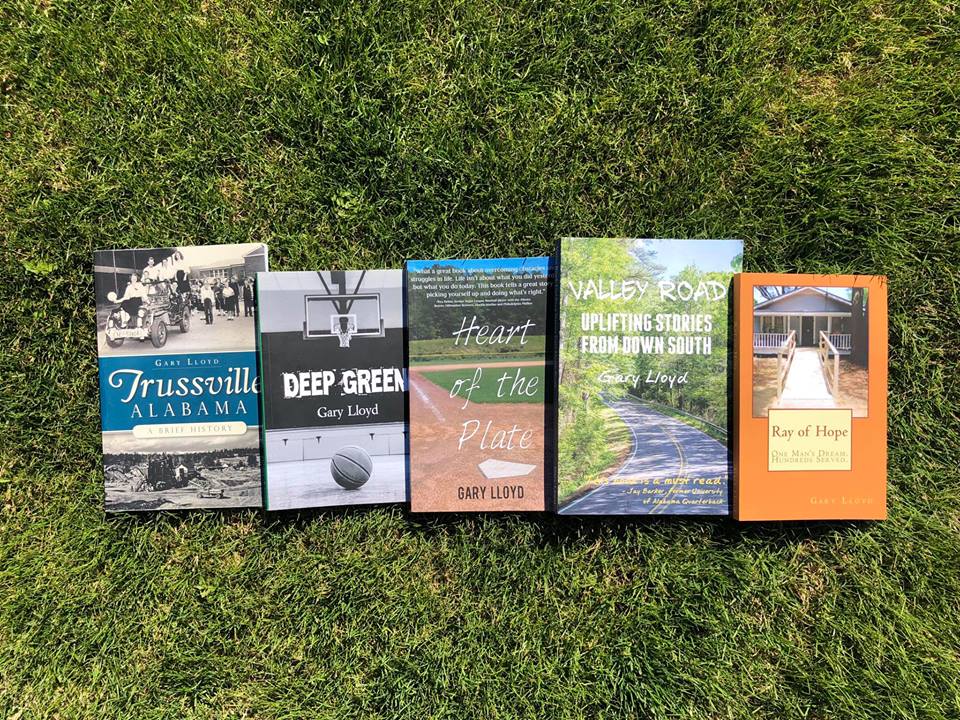
A rundown on my 5 books

My full house is complete. 

Two fiction novels and three works of nonfiction. 

And due to work and graduate school, I may not be publishing another book for quite a while, despite having several ideas in mind. Who knows, though? Maybe I’ll have another published in the near future. It’s something I love doing.

So, in the meantime, why not provide a quick video rundown of Trussville, Alabama: A Brief History, Deep Green, Heart of the Plate, Valley Road: Uplifting Stories from Down South, and Ray of Hope?

In the video, I briefly talk about each book, summarizing the plot and letting you know where you can find each. I even profess my feelings for the Atlanta Braves, a tumultuous relationship that I can’t seem to quit.

Please share this post with your friends!

Check out the video below.

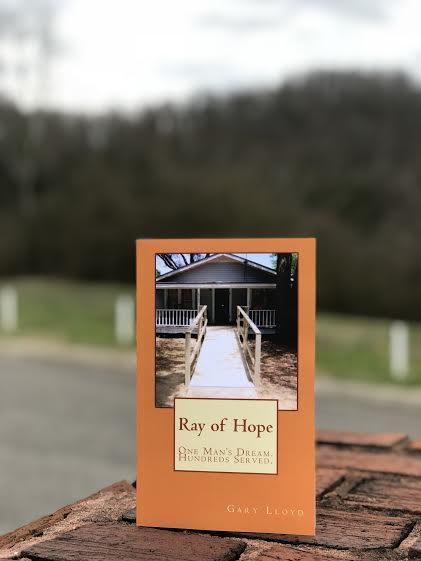
New book chronicles Florida wheelchair ramp ministry

All proceeds to benefit Ray of Hope nonprofit
 
MOODY, Ala. – Author Gary Lloyd has released his fifth book, Ray of Hope.

Jimmy Ray was quiet, shy, and humble, but even the most unassuming people have burning passions in their hearts. Jimmy’s was for the disabled, those in northwest Florida who were stuck inside their homes because they could not afford to have wheelchair ramps built. That bothered Jimmy to his core. He began constructing wheelchair ramps with the help of his wife and young daughter, and along the way, a church ministry was born. It became Jimmy’s mission in life. Men, women, and children volunteered. Money and materials were donated. More than five hundred lives were changed forever. In Ray of Hope, Jimmy’s passion is revealed by family, friends, and more than a dozen people who received wheelchair ramps when they had nowhere else to turn. 

Jimmy was Lloyd’s father-in-law, but Lloyd never had the chance to meet him. Jimmy died on Feb. 28, 2010, two years before Lloyd met his daughter, Jessica. Ray of Hope’s publication date is eight years to the day after Jimmy’s death.

“The idea for this book came in 2016 on a ride to the Atlanta airport,” Lloyd said. “Jimmy’s wife, Ramona, was driving Jessica and me there for a trip we were going on, and we spent some time talking about Jimmy and the Ray of Hope organization, which builds wheelchair ramps for those in need. I discovered that the nonprofit had built more than 500 ramps in northwest Florida alone, and I knew that this man’s story, this ministry’s purpose, needed to be told in a book.”

Ray of Hope was published through CreateSpace Independent Publishing. The book is available on http://www.Amazon.com for $10 and on Kindle as an e-book for $7.99. All proceeds from the book’s sales will benefit the Ray of Hope nonprofit organization.
 
Lloyd is also the author of Trussville, Alabama: A Brief History, Deep Green, Heart of the Plate, and Valley Road: Uplifting Stories from Down South. 
 
Lloyd has been a journalist in Mississippi and Alabama. He grew up in Trussville, Ala., and earned his bachelor’s degree in journalism from The University of Alabama in 2009. He lives in Moody, Ala., with his wife, Jessica, and their two dogs, Abby and Sonny. 
 
For more information, email garylloydbooks@gmail.com. Also visit http://www.garylloydbooks.squarespace.com and Like his author page at http://www.facebook.com/GaryLloydAuthor. 

For more information about Ray of Hope, find the “Ray of Hope Wheelchair Ramps” page on Facebook.

-30-

‘I have fought a long fight’

I can count the number of concerts I have attended on one hand.

In high school, I saw P.O.D. in downtown Birmingham with a few friends.

There was the time last year when Colt Ford, Justin Moore and Brantley Gilbert came to Birmingham one warm night. There was the time Morgan Wallen, Nelly, Chris Lane and Florida Georgia Line shared the stage on a cold night at the Oak Mountain Amphitheatre. 

But this week, I tried something different. My wife and I went to Iron City in downtown Birmingham, a venue that fills up an hour before the opening act takes the stage. We went to see Walker McGuire and Kane Brown.

We stood in a line that wrapped around two buildings, among teenage girls with Kane Brown photos used as their iPhone wallpapers, with twenty-somethings who could have used perhaps six more inches of material on their dresses. 

Inside, we smelled enough cheap cologne to singe nose hairs and tried to find a quiet spot on the mezzanine. It was crowded, loud, hot, and I felt as if these types of events had passed me by. I’d be lying if I said I was looking forward to standing for three straight hours amongst the screamers and the beer-drinkers. 

But something great, in addition to the music, happened.

Up on the mezzanine were a dozen or so reserved tables. We stood directly behind one, and I mentioned to my wife, “Must be VIP.”

The table’s occupants showed up close to showtime, both women. One was bald, with gold crosses dangling from her ears. She was there to see Kane Brown, and she was excited. She even brought a small sign that referenced one of the country artist’s songs. It read, “This Is My ‘Last Minute Late Night’ Before My Surgery.” Surgery was underlined. She taped that small sign to the mezzanine railing, hoping the budding country star would see it. 

As the night went on, she asked my wife to take photos of her and her friend. My wife, of course, did.

I found out the woman, named Merin, has Stage 2 Triple Negative Breast Cancer, diagnosed June 5 of this year. She had port surgery just over a week later and has since had four rounds of Red Devil chemotherapy, and twelve treatments of Taxol and Carboplatin. One treatment a week for twelve weeks.

Someone at the concert asked when Merin, from Pell City, was having surgery. The surgery is this Dec. 12, a double mastectomy and reconstruction. She will have to spend four or five days in the hospital, and will also have four drains and expanders for a few months. 

“It was very important to me to be able to have a fun night out,” the woman told me. “I’ve only had a six-week gap in between my chemo treatments and surgery day.”

She told me that she was in Atlanta for the Luke Combs concert the previous night. She was having her own “last minute late nights” before life changes for a long while. 

“After surgery I really won’t be able to attend any more concerts for a while just because of risk of getting sick or bumped into,” she said. “I don’t know how after surgery I will be feeling. The doctors told me around a year or so. My next concert I’m going to shoot for is Florida Georgia Line, Luke Combs or Carrie Underwood.

“I have fought a long fight,” she said. “You always think, ‘Oh my, I feel bad for someone who has cancer.’ But until you live it you really have no idea how bad it is.”

It is tough financially and emotionally. The woman has a seven-year-old son she calls “wonderful,” and he needs his mother. He has had to help her more than any kid should have to. It’s not fair to him, she told me. 

“I will be glad when this is all over with so he can be a kid again, and I can take back my role as mom,” she told me. “I trust in the Lord to guide my family and I in the right direction. With Him, anything is possible.”

The concert was awesome, and I know this woman enjoyed it. I could see it on her face, hear it in her screams as Kane Brown performed “Last Minute Late Night” and “Learning” on stage. 

Kane Brown never saw her sign, as far as I know. The room was too dark at times, and too bright with purple lights at others. I wish he would have seen it, and gotten to meet this special woman.

I checked Kane Brown’s social media channels two days after the concert, just to see if he posted anything from his trip to the Magic City.

His two Tweets since the show: “My job’s to bring light into other people’s lives” and “You’re special.”

If he didn’t see that woman’s sign, you could have fooled me with those Tweets.

Book of inspiring stories releases Sept. 15

MOODY, Ala. — Gary Lloyd has released his fourth book, Valley Road: Uplifting Stories from Down South.

The book is broken down into three parts: People, Places and Play. 

In the People section, Lloyd tells stories of inspirational people, from a BMX stunt team motivating a school of elementary students to a man with severe Alzheimer’s miraculously remembering how to play a specific song on the piano. 

In the Places section, Lloyd takes readers on a heartening and descriptive ride through the foothills of the Appalachian Mountains, to the concrete jungle of New York City, to the Green Monster at Fenway Park, to the azaleas at Augusta National Golf Club, and many places in between. 

In the Play section, high school coaches from around the Southeast tell their favorite stories, words that have never made the Sports section of their local newspapers. In exclusive interviews with Lloyd, they talk about why they became coaches, about basketball saving lives, about baseball players gathering for Bible studies, about a serve-others-first mentality.

“This has been a book I wanted to put together for a long time,” Lloyd said. “So much focus these days is on the 24-hour news networks, the horrible things that people say and do. I believe this is a book that many people need to read these days. They need to know that life in the 21st century is about much more than political debates, riots and negativity. This book is a collection of stories about the good in the world, about undisturbed land in Ellijay, Georgia, about ‘Stop For Prayer’ signs in the Wal-Mart parking lot, about a man retiring after more than fifty years in city service pleading for his wife to be thanked publicly for her support.”

Former University of Alabama quarterback Jay Barker, who led the Crimson Tide to the 1992 national championship, praised Valley Road.

“Gary shows in this book how coaches, youth pastors and community leaders truly impact the people around them and in turn impact communities in such a positive way. Each chapter demonstrates the positive impact of such people and reminds me of how such people have impacted my life, and encourages me and others to do the same. This book is a must read and one that hopefully encourages us all to realize the impact we can have on the people around us.”

Sean Dietrich, the author of seven books about life in the American South, also commented on the book.

“Gary Lloyd writes with fervor that leaves the reader feeling something akin to a plate of blackberry cobbler—with vanilla ice cream, of course. This book, and Gary himself, are gems in this world.”

Valley Road was published through CreateSpace Independent Publishing. The book is available on www.Amazon.com for $10 and on Kindle as an e-book for $7.99.

Lloyd is also the author of Trussville, Alabama: A Brief History, published by The History Press in 2014. He has also written two novels, Deep Green and Heart of the Plate, also available on Amazon.com. 

Lloyd has been a journalist in Mississippi and Alabama. He grew up in Trussville, Ala., and earned his bachelor’s degree in journalism from The University of Alabama in 2009. He lives in Moody, Ala., with his wife, Jessica, and their two dogs, Abby and Sonny. 

For more information, email garylloydbooks@gmail.com. Also visit www.garylloydbooks.squarespace.com and Like his author page at www.facebook.com/GaryLloydAuthor

Authors

When you tear the tape on the heavy cardboard box delivered by UPS, dreams tend to pour out. 

You run your fingers across the matte covers of a hundred books, and you almost can’t believe it’s your name printed on them, your words in black ink inside. It’s surreal. 

You have grand visions for your future. You see a line of people out the door at Books-A-Million and Barnes and Noble, clutching your book for you to sign. You see news articles about your book in publications across the country, praising its prose and description, and maybe it’s even on the bestsellers list. You see royalty checks rolling in that pay for vacations to the beach. 

Those are all extreme examples, but you dream of them, at least a little bit. Why do something if you don’t want it to be the best? But the harsh truth is very few authors reach the mountaintop of writing books, where all you do is write bestsellers that are turned into blockbuster movies. For most of us, it goes a little something like this. 

Your first book signing ever is held at a posh store near Birmingham, Alabama, where your name and photo appear on a large poster outside. You feel like royalty. You sign a couple dozen pre-ordered books in a back room. You expect to do the same in the two-hour event that follows, but mostly you chat with the store owner about his business model, and with your parents about what’s for dinner later. You sell two books to the same man. 

Your next signing is at a bookstore not far away from the first one, and maybe ten customers come in the two hours you are there. About four acknowledge your existence, as if you are the DirecTV rep begging for people’s time in Wal-Mart. You play Hangman on notebook paper with your wife to pass the time, which helps. You sell no books, but you beat your wife in at least one game of Hangman. 

Your next signing is the one you are looking forward to the most. You just know that the third time is the charm. It is in your hometown, which is also the focus of your book. The event is in a high-traffic area, near an Old Navy and a Target. It’s on a Saturday. This will be great. The publishing company has sent posters previewing your signing to be taped to the windows, so folks will know when to come by. You arrive, and the employees have no clue who you are, or about any book signing event, for that matter. You have been forgotten, and you sell one book. You try to ease your anger about the store’s forgetfulness with more games of Hangman. This time, it doesn’t help much. 

Your next signing event is a true act of desperation, held at a large grocery store in a city full of people who have never heard of you or your book. You wonder why this was even scheduled. You sit near the small section of books the store carries, and awkwardly watch as people push shopping carts full of Gatorade, chicken breasts and vanilla ice cream. One man is intrigued by your work, and he asks you a dozen questions as he flips through your book. He does not buy it. 

This is rock bottom. You wonder if those eight months of research pressed into more than one hundred pages was worth it. You didn’t write the book for the money, but sitting for two hours without selling one is embarrassing and seemingly a waste of time. Then, something great happens. 

You publish your second book, and a church invites you to talk about it and sign copies. You are nervous, because talking in front of a crowd does not exactly seem easy. But you do it anyway, because it is marketing for your book. It goes surprisingly well. You talk for half an hour about your inspirations and the book’s plot, and answer a dozen questions. You connect with this group, and their laughs don’t sound like pity. Almost every little old lady that Wednesday night buys a book. You make five hundred bucks and give some back to the church. You are energized to do more. 

You put out a third book, and it’s back to the drawing board. You promote as much as you can on social media, begging for likes, retweets and positive Amazon reviews. Mostly, those come from your wife and mom. You spend hours looking up independent bookstores in every state, emailing them about your new book. You email a hundred stores and get four responses, all with words you weren’t hoping for. You do the same with various newspapers, hoping for any bit of publicity. You get three stories locally and one in Mississippi. You take your new book and the first two to many locations to snap photos of them for social media promotions. You take photos at a river, baseball field, church parking lot, abandoned business with a rusting door, Turner Field in Atlanta and even your driveway. You hope those images, along with excerpts from the books, draw attention. 

Finally, it’s time for another book signing. You’ve never attended one where there are a dozen authors, but it sounds like a good idea. There will be many people with various tastes, you believe. It is held at a general store just outside the main shopping district in town, where there is not much around. You load your own table and chairs, and a box of books. Because it is held in December, your wife bakes Christmas cookies for the event. Authors are scattered all over the store, between old Texaco signs, a crock pot, carved crosses and other antiques. 

One author has written about her experiences with cancer. Another has written a children’s book. A woman has written about adoption. One man, with more than five books to his name, plays a guitar at his table. Another man, who calls you “Brother,” passes out a poem he wrote that he printed on computer paper. Not many people come to this store during the four hours you are scheduled to stay. Four hours feels like eight. You sell one book, to a man who is about to undergo surgery and needs all the reading material he can get during his rest and rehab period. 

Six months later, you sign up for another large event, this one at a state park along a huge lake. It’s summer, and you assume that it will be well attended, with people swimming and fishing nearby. There is room for fifty authors. Fifteen or so show up. The authors are set up right on the lake, and you’re visited more by hungry mallards than locals seeking the latest in Christian fiction. You feed chili-cheese-flavored Fritos to the ducks and kick yourself for not bringing your rod and reel.

You sell two books: one to your mom for one of her friends, another to the wife of a co-worker. You mostly spend the day talking with fellow authors, about their inspirations and writing processes. You learn about how a man stumbled upon hundreds of documents that told the story of his father in World War II. You learn about adoption. You learn what it takes to write more than three hundred pages. More than anything, you learn about people. You get to know these people better. They become friends and supporters. 

You sell only the two books that day, but you soon realize that might be more than the others sitting near you sold. Some have traveled far for this event, and you feel for them. You help one author take his books back to his car. But they are happy, not deterred by going home with the same amount of books they brought. It is their passion, this writing thing. You learn, after three years grinding in this industry, that money isn’t everything. The industry, like most everything else, is about relationships. Your wife has been to all your events, baking cookies for them, taking in the little bit of money you make, smiling through dozens of games of Hangman. Your mother-in-law has driven to each book signing since she’s lived in Alabama, and even made you a book-themed tablecloth that is asked about and complimented by fellow authors at every event. Your parents and brother have come, and they have bought copies at signings even though they know you’d give them books for free. 

I didn’t get into this industry to make thousands of dollars, though a few hundred would be nice. I did it to tell stories that are worthy of sitting on your bookshelf or coffee table, to put something in print that provides some light in an increasingly dark world. Who knows, maybe some day long after I’m gone someone will read one of my books and say, “I needed that.” I’m going to keep writing as long as I’m able, with that in mind. These authors I sit with in an old general store or in the blazing heat to sell maybe one book inspire me. They fuel my passion. I hope I fuel theirs.

And that’s worth more than any royalty check. 

Words and Baskets

Jessica Lloyd

How on earth do words and baskets tie together? It’s a question I asked myself many times when I was first getting to know my husband. He would watch sports, of any kind minus soccer, for hours. I repeat, hours. But basketball, that’s always been his favorite. He’d skip dinner or outings if it meant catching a few minutes of an Alabama basketball game, which also added to my confusion. Alabama basketball has been downright awful for several years now; I’d hear him hollering from the other room at the TV in frustration. Why spend so much of your time watching a team you know will lose to the team I’d never even heard of before? And just as quickly as the game was over, Gary would be back in the office, writing. A 180 degrees from what he was doing just minutes ago … quietly scratching down ideas in his black, spiral bound notebook he’s frequently seen with or typing away on the Mac. 

It took a while for me to realize that Gary was not the one-sided guy most would guess him to be when he runs down the statistics of baseball games from thirty years ago or talks about Alabama football’s newest recruits. And he was also not the boring words guy; correcting me lovingly to this day when I say “four cent” instead of “cents.” These two things, words and baskets make up a huge part of who Gary is. From the time he could walk, he was playing a sport. It’s just what you did growing up a boy in the South. And he grew up loving it. I still hear stories about how late into the night his parents would hear the tap, tap, tap of the basketball outside on their driveway. 

But Gary also loves writing. He can put words to paper and tell a story that people want to read. I’ve seen him write stories about football players, genius kids ahead of their time, young men fighting cancer and the people behind growing businesses and towns. He’s covered more sporting events than I can count; sometimes I’d tag along…mostly for the concession stand food and the chance to see him work. 

Eventually, as he got older and more practiced in his writing he began to morph those two worlds together. Taking one passion and making it come alive with the other. He’s been talking about his new book he’s been working on for a while; long before he met me actually so it’s hard to call it new. But it’ll be new to you when it comes out. He’s put his heart, his love for basketball and sports, his love for writing and telling a story into this book. I hope you’ll check it out when it’s available and find out for yourself about words and baskets.